learning

Participation Inequality

Most people are lurkers. Jakob Nielsen, writing on participation inequality, states:

  • 90% of users are lurkers (i.e., read or observe, but don't contribute).
  • 9% of users contribute from time to time, but other priorities dominate their time.
  • 1% of users participate a lot and account for most contributions: it can seem as if they don't have lives because they often post just minutes after whatever event they're commenting on occurs.

These percentages vary somewhat according to type of site (see Quantitative Analysis of User-Generated Content on the Web by Ochoa and Duval via Robert Hughes). Nielsen notes,

Blogs have even worse participation inequality than is evident in the 90-9-1 rule that characterizes most online communities. With blogs, the rule is more like 95-5-0.1.

Participation inequality is a fact of life. Suw Carman adds that in and of itself, is not a problem.

Still, it is possible to decrease the number of lurkers a little by making it easier for them to participate. Conversely, of course, the percentage of lurkers is likely to increase as the difficulty to contribute increases. In the case of trackbacks, as posting on one's own website requires more time than simply rushing off an "I agree" comment, the number of trackbacks will be smaller as they are more difficult than commenting. Looking at EFL Geek's statistics (before his new redesign), we see that he had written 1007 posts, received 1924 comments, 50 trackbacks, and 184 members. These statistics support the previous post's speculation that trackbacks took too much energy for people to use as compared to commenting.

Comments are Uninteresting

On enabling comments, Nielsen writes,

I would say to only allow comments if you have the time to moderate them. Otherwise, your site will suffer information pollution and waste readers' time because of the dominance of uninteresting comments.

I don't imagine that this site would ever have so many comments as to require much time to moderate them, but as, he notes, most comments are just "uninteresting." However, that assertion also has qualifiers. In analyzing the collaborative nature of the Web, he compares chat and discussion forums, writing that although most discussion forum posting are "uninteresting,"

the longer postings [in discussion forums] typically lead people to include some arguments and not just pure name-calling [compared to chat rooms]

This is in line with my earlier posts concerning commenting. In Monologic and Empty Comments vs. Parallel Conversations, I looked at comments on the sites of two well-known bloggers:

When I counted, out of the 58 comments on Brogan's post, perhaps 20% of them said something that added "content." Out of the 141 on Arrington's (not including trackback, which have a higher percentage of "content"), it seemed to be a little more than 20%. (I stopped counting quickly as my eyes glazed over.) Now, a few of the 20% were very good. Still, most comments were simply thanks, pats on the back, or repetition of something already said, without reference to others in the "conversation."

Learning from comments like these, which are fairly normal, is about as easy as learning in a room full of speakers, each with a megaphone shouting out their own opinion.

Generating Quality Comments

The exceptions to these types of comments tend to be found on blogs like that of the Becker-Posner Blog. The more serious the tone, the more knowledgeable the article, the more specific the focus of the blog the more specific, knowledgeable, and serious the responses will be. As mentioned two years ago in Rethinking Comments and Trackbacks, comments differed quite a bit, depending on the blog:

Over at weblogg-ed, I looked at the first 30 comments. The overwhelming majority of comments were in agreement with Will's position, sometimes adding a twist on it, but mostly agreeing.

At Creating Passionate Users, we see a different picture on one post, "Intuition", which had 15 comments when I looked at it. Three comments added nothing, but the majority added some point that was slightly new or gave a different perspective.

At "Half an Hour," Stephen Downes writes about "Adults and MySpace". It's a long article: 1758 words. It has two comments, one with 78 words that doesn't add much, and another with 280 words that adds new insight into the issue of adults on MySpace.

So, quality comments are possible, depending on the quality of the post. One other factor in getting quality comments is your responses to commenters. Referring to business, Nielsen writes,

Promote quality contributors. If you display all contributions equally, then people who post only when they have something important to say will be drowned out by the torrent of material from the hyperactive 1%. Instead, give extra prominence to good contributions and to contributions from people who've proven their value

Applying that to education blogs, respond in kind to comments that add some new insight into the topic at hand, and ignore those that add nothing.

Learning through Comments

For our students, Mary Hillis has a suggestion:

After the first week of the Book and Literature Circle Blog, I found that students wrote short comments, and there was no flow between contributions in the comment area. During the second week (this week), I specifically asked students to think about how they could connect their comments to previous ones and build up a conversation.

Thinking about participating in academic discussions, and synthesizing sources in academic writing assignments, I think that by challenging students to make connections between their comments and their classmates' comments, they are learning a valuable communication skill that they may be able to apply to other types of assignments.

This approach fits in well with Graff and Birkenstein's book They Say / I say, which

shows how academic argument is a dialogue in which an individual acknowledges what others are saying and at the same time makes a space for what s/he is saying.

As Mary noted in her other post on comments,

commenting is a skill that students need some guidance on

So, along the lines of making connections and synthesizing, I would help the students consider how to remix their comments and those of others (and of course giving credit appropriately) with the goal of coming up with new insights into the issue at hand. Perhaps, in this way, good comments can be generated, and learning might take place.

About two weeks ago, Claire Thompson, upon finding that I didn't allow comments initially was "aghast" and wrote,

On my blog comments were my riason d’etre. What was wrong with this guy? If only I could give him a piece of my mind…"

I'm glad that I wasn't close at hand then. :)

She then went on to a brief but thoughtful consideration of the pros and cons of having comments. One point she made that I hadn't given much thought to before was that many readers are not likely to follow trackbacks. Comments have a time advantage by having the entire conversation in one place.

I'm not sure why readers don't follow trackbacks, but I believe that many want to skim something quickly, and if it attracts them enough, they will slow down to think about it. Going after trackbacks simply doesn't have a sufficient level of catalytic attraction to get them to click. That applies to me, too, because often all trackbacks do is quote part of a post from which I can't determine if it's worth my time to click on it. Trackbacks need to have a few words that indicate the value/substance of the reply sufficiently so that I want to see what they have to say. As Christine Martell, one of the commenters on Claire's post, stated,

I don’t check out trackbacks on others posts unless the blogger points them out in a subsequent post. I’m even clicking on less and less links in a post unless the blogger gives me a sense of why I should. I’ve just gone down too many paths of check out this post only to find out it doesn’t add a lot of value for me.

Similarly, the large majority of readers do not want to expend the time and energy in writing a lenghty and thoughtful comment. In the two years since I initially gave my rationale for no comments, not one reader has taken me up on my invitation to send me by email a thoughtful and measured response to anything I've written for posting on my blog. (Before that time, two individuals did post lengthy responses on my blog, one, a colleague whose response I invited.)

Now I do think that some blogs are meant for comments. Technical ones are a good example, in which a large number of people can bring together isolated pieces of information, giving readers a much better grasp of possibilities for resolving some problem. And some blogs seem to encourage good comments, such as the Becker-Posner Blog.

But many blogs (I would say most), for whatever the reason, have too many comments that add nothing but feelings. As Claire noted, this post

by Will Richardson has garnered 68 blog reactions and 166 comments to date. What could someone possibly add to the conversation at comment 166? I don’t know, but they must feel pretty stongly to add their 2 cents worth.

For these reasons, I don't think comments are best for students because they often take the path of least resistance due to time pressures, such as work, family, and so on. The goal for blogs used in classes has to be learning, but the instantaneous nature of comments inhibit reflection. Then, again, as Mary Hillis wrote,

commenting is a skill that students need some guidance on.

From this perspective, with guidance, perhaps commenting can be a learning endeavor. Before assuming that comments or no comments are better, we should be able to answer questions like these:

  • Is commenting as effective for learning as writing a post on one's own blog and trackbacking to the initial post.
  • Does posting on one's own blog reduce the tendency of confirmation bias that is found in comments?
  • Does the social nature of commenting (compared to trackbacks) motivate students more to continue their learning via blogs after the class ends?

Each of these questions would make for a good study, and at the least require some thought before assuming that comments are important for learning.

Although I lean against commenting, I do not see it as black and white. There's no research along these lines that I am aware of that can give definitive answers according to type of blog, context, and so on. But for those of us who are educators, I would say that we need to be careful about being sidetracked by the social contagion of commenting and instead keep the goal of learning in the foreground of our blogging and of our students' blogging.

Related posts can be found at Why I don't have comments.

Abstract is better than concrete for transfer, according to the New York Times reporting of recent research in mathematics:

In the experiment, the college students learned a simple but unfamiliar mathematical system, essentially a set of rules. Some learned the system through purely abstract symbols, and others learned it through concrete examples like combining liquids in measuring cups and tennis balls in a container.

Then the students were tested on a different situation — what they were told was a children’s game — that used the same math. “We told students you can use the knowledge you just acquired to figure out these rules of the game,” Dr. Kaminski said.

The students who learned the math abstractly did well with figuring out the rules of the game. Those who had learned through examples using measuring cups or tennis balls performed little better than might be expected if they were simply guessing. Students who were presented the abstract symbols after the concrete examples did better than those who learned only through cups or balls, but not as well as those who learned only the abstract symbols.

The problem with the real-world examples, Dr. Kaminski said, was that they obscured the underlying math, and students were not able to transfer their knowledge to new problems.

“They tend to remember the superficial, the two trains passing in the night,” Dr. Kaminski said. “It’s really a problem of our attention getting pulled to superficial information.”

The explanation of examples clouding up the concepts reminds me somewhat of the research on reading about seductive details diminishing recall of information. (There are many articles on this phenomenon, but see, for example, Processing and recall of seductive details in scientific text.)

Transfer is also a major problem in writing: Students often don't transfer what they know about writing in one situation to new situations. Somehow, the situations are compartmentalized so that the concepts don't transfer, which remains me of the research on students learning physics. David Hammer's research showed that students could compartmentalize and keep their every day notions about motion from the physics concepts they were learning.

So, although this was a small study (and one that needs to be replicated), it does fit in with what we know of transfer, that learning that is bound to a particular context doesn't transfer well--which explains why students who have learned the five-paragraph essay structure in high school continue to use it in college even when an assignment requires them not to.

What would be the abstract set of rules for writing? I've looked at that before, except I called them "building blocks." But although I can see the need for knowing the building blocks abstractly, I think mastering them abstractly is achieved through much practice of remixing these building blocks across contexts. (See Learning by Remixing and also this review/synopsis of Spiro's Cognitive Flexibility Theory.)

The problem remains determining what those building blocks are. Although they likely differ across genre (just as math concepts differ from geometry to algebra to calculus and so on), they must also have elements in common. At a basic level, there's always writer, audience, text, and purpose. For persuasion, it may come down to the formula in Graff and Birkenstein's book "They Say / I Say", in which writers join into a conversation with others and position themselves with respect to those others. It's a small book with three parts and ten chapters:

Part 1. "They say"

ONE: "They say" (Starting with What Others Are Saying)

TWO: "Her Point Is" (The Art of Summarizing)

THREE: "As He Himself Puts It" (The Art of Quoting)

Part 2. "I Say"

FOUR: "Yes / No / Okay, But" (Three Ways to Respond)

FIVE: "And Yet" (Distinguishing What You Say from What They Say)

SIX: "Skeptics May Object" (Planting a Naysayer in Your Text)

SEVEN: "So What? Who Cares?" (Saying Why It Matters)

Part 3: Tying It All Together

EIGHT: "As a Result" (Connecting the Parts)

NINE: "Ain't So / Is Not" (Academic Writing Doesn't Mean Setting Aside Your Own Voice)

TEN: "In Other Words" (The Art of Metacommentary)

As you can see, despite having only two building blocks--"they say" and "I say"--students are led into a variety of ways of analyzing, synthesizing, and evaluating what "they say," along with generating their own understanding and position among others in a conversation. And treating persuasive writing like a conversation has many connections to students' lives: They argue about their sports, clothes, cars, majors, professors, and so on.

I imagine that different sets of building blocks are possible, just as different sets of rules can be found in different fields of math. The key seems to be helping students practice using one coherent set of building blocks (i.e., abstract principles) across contexts.

Related posts:
The Five-Paragraph Essay and Building Blocks of Writing
The Five-Paragraph Essay (continued)
Learning by Remixing

For those interested in getting a better understanding of how learning occurs, see the following websites:

Explorations into Learning and Instruction: The Theory into Practice Database. Maintained by Greg Kearsley, it's quite useful for brief introductions into learning theories, domains, and concepts.

EmTech has "over 15,000 resources organized by topics for teachers, students, and parents" with this page of links to learning theories.

See also Kathy Sierra's Crash Course in Learning Theory.

Michael Shaughnessy (Ednews.org) interviews E.D. Hirsch on school choice and the Core Knowledge Curriculum, and they discussed an article by Sol Stern and reactions to that article by E.D. Hirsch and others such as Jay P. Greene, Diane Ravitch, Neal McCluskey, Matthew Ladner, Thomas W. Carroll, Andrew J. Coulson and Robert Enlow. Here are two excerpts from the interview:

Critical thinking skills cannot be learned in the abstract.They always pertain to concrete knowledge of subject matter.I review the scientific literature on this in The Schools We Need.Writing skills are obverse of reading skills.They both depend more on knowledge of the unspoken within the language community than on knowledge of the spoken.The main, somewhat revolutionary point I have been making is that teaching content is teaching skills, where as teaching formal processes is, in the end, teaching neither content nor skills.This is not only clear in the scientific literature, it is also clear from comparative results.Students who have had been taught coherent knowledge are more highly skilled than those who have been taught "skills."See the (unfortunately repressed) book by the late Jeanne Chall: The Academic Achievement Challenge

The state standards in language arts (where students spend most of their time in early grades) are empty of content.It's all process.They are not standards at all in a meaningful sense.And they cause reading tests to be hugely unfair, because the topics in passages on reading tests always assume content knowledge that has not been taught in the schools.

This makes sense to me. Just try reading a treatise on quantum mechanics. Without a strong background in physics, any previous critical thinking skills you've acquired will be useless in interpreting this text.

This is one of the problems in many first-year composition programs: They teach the process of writing with limited content knowledge. Usually, students will choose one issue for, say, a definition paper, then another topic for an evaluative argument, and so on. Moving from content area to content area shortchanges students' ability to master process skills, as they must learn two areas: content knowledge and skills.

A better approach is to have students stay with one issue of their own interest the entire semester. In that way, they'll build their content knowledge, so that as the semester continues, they can begin to pay more attention to the critical thinking and writing skills associated with that domain. I noticed the Department of Rhetoric & Composition at UT Austin seems to be doing that now in First-Year Writing.

Of course, there's still the question of whether the writing skills they've learned will transfer to other courses not pertaining to those issues. My guess is they will have some chance of transferring, because the knowledge required in introductory courses is "introductory", unlike the knowledge in the example on quantum mechanics, meaning also that the skills acquired should be more general in nature. Testing that guess would make a good research project.

Ever notice that students seem to learn a particular rhetorical convention or grammar point, then go back to an earlier stage of writing. I've noticed that my learning seems to take one step forward, and then regress, too.

One Step Forward
A year ago. I had finally got around to fixing the trackback on my blog. It seemed strange: Although my page template had scripts for Haloscan but not for Yahoo maps api, the html code showed the latter but not the former. Apparently, around January while playing with the design, I changed which templates were being referenced to an older version in another folder. What led me to looking for the template location was something that Mark Bernstein, the designer of Tinderbox (the software I use to write this blog) had said on more than one occasion: Look at the HTML code.

Easy enough to change folders. After fixing it, however, I created another problem. After I added google analytics script to the page template, the sidebar dropped below the posts. It made no sense that the one would lead to the other, but I took the script out anyway. Sure enough, that didn't fix it. Comparing my template with another orginal one, I saw that somehow, while pasting in the script, I had somehow deleted six important characters after the post division: </div>.

One Step Forgotten
Apparently, despite the many times Mark has advised me to look at the HTML code and the few steps I've taken in doing so, I may still forget to look at the code. On Thursday, I downloaded Tinderbox 4.0. When I looked at the web version of a post I was working on, there was no formatting. It was as if the CSS had disappeared. For some reason, I didn't compare the before and after HTML codes. If I had, I would have seen that they were different. Anyway, I emailed Mark, who replied:

Also, there's a warning in the release notes about stylesheet export -- a new tag pair

HTMLIndentedParagraphStart/End

need to be redefined as empty strings for notes that are exporting stylesheets or other code where paragraph markup is unwanted.

Sure enough. That was the problem. And another problem was that I hadn't seen the release notes. Usually they're included in the DMG image, but not this time. Now, common sense might've told me to look in the Help menu, but I didn't. After all, they hadn't been there before. It took another email from Mark to direct my attention to this possibility. It's hard to see something when you're looking in the wrong direction.

Like Student, Like Teacher
I'm much like my students. That is, although everything that Mark had told me was pretty much common sense, at least for someone who was overly familiar with Tinderbox, HTML, and CSS, it wasn't so for me. And although everything that I tell my students is common sense, at least for someone like me familiar with English, writing, and language elarning, it isn't so for my students. And like me looking at HTML code, my students often zigzag in their ability to remember grammar points like subject-verb agreement and rhetorical conventions, such as framing quotations. Why would that be?

Forgetting and Learning
Anderson and Schunn in their article "The implications of the ACT-R learning theory: No magic bullets" (pdf) state that there are three learning processes (at the subsymbolic level):

1. Power Law of Learning. As a particular skill is practiced there is a gradual and systematic improvement in performance which corresponds to a power law. ...

2. Power Law of Forgetting. As time passes performance degrades, also according to a power function. ...

3. Multiplicative Effect of Practice and Retention. Most important, the Base-Level Equation implies a relationship between the combined variables of amount of practice and duration over which the information must be maintained. ...

This implies performance continuously improves with practice ... and continuously degrades with retention interval .... Most significantly the two factors multiply which means that increasing practice is a way to preserve the knowledge from the ravages of time.

As these are power laws, learning is a logarithmic function:


Picture by Hay Kranen / PD

In other words, (1) with practice, learning increases quickly; (2) with a lack of practice, retention of learning drops off quickly; and (3) the effects of (1) and (2) interact in a way that multiplies each other rather than just adds up.

In my case, I seldom look at release notes, infrequently look at HTML and CSS, and so easily forget. In the case of students, although they may be using English every day and may be writing every few days, they are only reminded every few weeks about subject-verb agreement or rhetorical conventions, when after turning in a draft, they receive my feedback. Their time on grammar and rhetorical conventions is insufficient to stabilize it. So, sometimes they remember and sometimes they don't.

Understanding these power laws is crucial to helping students improve their writing. Most of the literature on grammar feedback and error correction with L1 students say that it doesn't work, and the L2 research has had contradictory results. However, it's unlikely that students in any of this research practiced specific grammar points frequently enough to stabilize them. Of course, it may not be feasible for most students to practice enough and for most teachers to give feedback frequently enough in order to take advantage of these power laws of learning and forgetting. I have no real answers at this time, but for some of my earlier thoughts on error correction, see my series of posts beginning at Error Feedback in L2 Writing.

Dave Munger reports on research testing the Sapir-Whorf Hypothesis that language influences our thoughts. In an experiment on distinguishing aliens,

The students who saw the labels learned the difference between approachable and unapproachable aliens significantly faster than students who didn't see the labels -- even though the labels gave them no information that wasn't available in the unlabeled condition. During the testing session, 8 new aliens that hadn't been seen before (but were clearly members of one of the categories) were introduced. Once again, the students who had seen the labels performed significantly better (no labels were present during the testing session).

Many of the students in the unlabeled group actually reported that they invented their own names to keep track of the two kinds of aliens. A second experiment confirmed the effect using spoken words as labels instead of written words. Interestingly, a third method of labeling, on-screen location, did not produce results significantly different from unlabeled objects.

Here, it seems, we have a clear case of language influencing thoughts. When people have a label for a category of objects, they learn how to identify objects in that category quicker than if they don't have a label. They're also better at identifying new objects that they haven't seen before.

These findings have implications for learning to write. That is, by giving students labels to recognize different aspects of writing, such as warrants for example, they will be able to recognize them more effectively in others' writing, and hopefully in their own writing. I've seen that in my own students' writing. One student, some years ago, wrote the following two observations in his journal:

Well, practicing, that’s good. ... rhetoric theory, it’s good, because ... you have to have some organization and I knew what was definition argument, and evaluation argument, but I didn’t have words and conceptions for this. ... You have kind of structure ... for some things, but rhetoric gives you concepts, it’s more easy to deal with it. ... sometimes we read something and you recognize this ... you know what the guy’s doing

I’m reading a text written by Galileo Galilei (1564-1642) in 1615 called “Letter to the Grand Duchess Christina” (Drake, S. Discoveries and opinions of Galileo). I’m astonished with Galileo’s power of argumentation! He defends his scientific cause within the theological affairs and gives good reasons! I observed that he used in his text arguments of character such as quotations of St Augustine and other greats figures of the church….

As you can see, by learning labels, such as "arguments of character," or ethos, he now sees them in his readings and understands how Galileo is using them. Of course, we all use labels to give us an easy way to talk about something, such as the present perfect tense in grammar or thesis statement in organization. But now we have a better reason to use labels: they facilitate learning new concepts.

Update:

Culture affects your brain according to recent brain research at MIT (Live Science via Neuroanthropology).

Neuroscientists Trey Hedden and John Gabrieli of MIT's McGovern Institute for Brain Research asked Americans and East Asians to solve basic shape puzzles while in a functional magnetic resonance imaging (fMRI) scanner. They found that both groups could successfully complete the tasks, but American brains had to work harder at relative judgments, while East Asian brains found absolute judgments more challenging.

It's possible that those preferences can change. From the article,

Gabrieli said he is interested in testing whether brain patterns change if a person immigrates.

"There's a hint that six months in a culture already changes you," he said, referring to psychological, rather than neurological, research. "It suggests that there's a lot of flexibility."

Although such findings could lead people to stereotype others, as Gabriele said,

I like to think the more you understand different cultures, the better you understand their perspectives."

Neuroanthropology gave the following information on the research:

Trey Hedden, Sarah Ketay, Arthur Aron, Hazel Rose Markus, John D.E. Gabrieli (2008). Cultural Influences on Neural Substrates of Attentional Control. Psychological Science 19 (1), 12—17.

ABSTRACT—Behavioral research has shown that people from Western cultural contexts perform better on tasks emphasizing independent (absolute) dimensions than on tasks emphasizing interdependent (relative) dimensions, whereas the reverse is true for people from East Asian contexts. We assessed functional magnetic resonance imaging responses during performance of simple visuospatial tasks in which participants made absolute judgments (ignoring visual context) or relative judgments (taking visual context into account). In each group, activation in frontal and parietal brain regions known to be associated with attentional control was greater during culturally nonpreferred judgments than during culturally preferred judgments. Also, within each group, activation differences in these regions correlated strongly with scores on questionnaires measuring individual differences in culture-typical identity. Thus, the cultural background of an individual and the degree to which the individual endorses cultural values moderate activation in brain networks engaged during even simple visual and attentional tasks.

These findings may explain in part why what is so clear to me as a teacher is not so clear to my students.

Learning Math via Sudoku, Music, and Web Design
In Who Needs Maths?, Andrew Hodges, maths lecturer at Wadham College, Oxford, states that mathematics would be better learned through logical puzzles like Sudoku and adds,

"We should be trying to find ways of equipping children with the basic maths they will need to function adequately in society. ... We should be looking at ways of teaching maths skills through other media, such as electronic music and web design, that are more relevant to most students."

Learning and Exercise
Use it or lose it! If you want to keep your mind in good shape, you need to use it, and there are recommendations from playing crossword puzzles to using your non-dominant hand for combing your hair. But did you know that you need to use your muscles to keep your brain functioning well? The article Lobes of Steel (New York Times) reports on research showing that regular aerobic exercise "boosts memory and cognitive processing speed" in both mice and people due to increased neurogenesis.

Students Remixing Teachers on YouTube
How would you like to be videotaped without your knowledge and then find yourself on YouTube? Students are now posting videos of their teachers on YouTube. Vaishali Honawar has a lengthy article, "Cellphone taping a classroom threat".

Faculty Grating Habits
From a study on Professors' Most Grating Habits, here are the top ten:

  1. Poor course organization and planning.
  2. Poor teaching mechanics (for example, poor use of the blackboard or speaking too fast, softly, or slowly).
  3. Lecture style and technique, including being too wooden or long-winded.
  4. Poor testing and exam procedures.
  5. Negative mannerisms, including attire and verbal and nonverbal tics.
  6. Monotone voice.
  7. Poor use of class time (for example, coming in late and stopping early).
  8. Intellectual arrogance--talking down to or showing a lack of respect for students.
  9. Being unhelpful and not approachable.
  10. Unfair or confusing grading process.

More bloggers are commenting on the myths of the Digital Generation.

Juliette White wrote of her misgivings on the notion of digital natives. As she notes, most of the evidence on their characteristics is "anecdotal."

George Siemens also critiques the so-called digital native/immigrant division of Marc Prensky, stating,

But I don't think the distinction has merit beyond a buzz phrase that has outlived the role it initially played in getting educators to think about the different types of learners now entering our classrooms.

the premise is wrong (and offensive), the remedy suggested is wrong, and the research is needlessly twisted to lead readers in directions at conflict with even the slightest amount of critical thinking. Prensky’s articles takes readers through a very shallow dive of a very deep pool.

Also critiquing Prensky's digital evangelism, Jamie McKenzie, in his article Digital Nativism, Digital Delusions, and Digital Deprivation (via George Siemens), gets to the point:

Prensky's labels are crude, inaccurate and based on no data. His gross generalizations lump complex segments together as if identical.

McKenzie's critique of Prensky is rather harsh, but he details how Prensky overgeneralizes, simplifies groups of people, and lacks evidence for his claims.

On a calmer note, Carrie Fried, Associate Professor of Psychology at Winona State University, conducted a study on how using laptops in class negatively affected learning. Her research is crucial because much of the earlier research, according to Fried, (1) did not objectively measure learning; (2) did not have a control group; but (3) prescribed how laptops could be used in the classroom. Although I wouldn't limit research to only experimental approaches, it is important that so far the effect computers on student learning has been left out. In addition to distracting other students, she found,

Students admit to spending considerable time during lectures using their laptops for things other than taking notes. More importantly, the use of laptops was negatively related to several measures of learning. The pattern of the correlations suggests that laptop use interfered with students’ abilities to pay attention to and understand the lecture material, which in turn resulted in lower test scores. The results of the regression analysis clearly show that success in the class was negatively related to the level of laptop use.

In other words, multitasking by digital natives decreases learning. Common sense dictates this finding: Learning depends on effective time on task (see Anderson & Schunn's Implications of the ACT-R learning theory: No magic bullets (pdf)), and dividing one's time among tasks lessens the amount of time devoted to any one task, along with losing time for switching between tasks. And other research has found the same results for multitasking. (See, for example, Brain, Cognition, and Action Laboratory and its Projects for links to online readings on multitasking and other cognitive processes.)

None of this is to say that computers cannot be used for learning in the classroom. Actually, they should be: They are part of the fabric in which we exist. Some research indicates that they can promote learning if used appropriately. (See again Fried's article and also this news about the Maine laptop project.) But also note that if used inappropriately, computers do nothing for learning.

So, we need to avoid the hype and exaggeration associated with the digital generation, focus on how Web 2.0 applications can support learning, and support instructors in gaining the skills to use these tools. Web 2.0 tools are not a panacea for ineffective instruction, but

  • They can engage students more than traditional forms of instruction.
  • They can enable students to interact with each other and others outside the classroom, thus
    • multiplying their exposure to course concepts and
    • motivating them to spend more time on task, the number one factor in learning.

Source:

Fried, Carrie B. (In press). In class laptop use and its effects on student learning. Computers & Education.

Related posts:
Myths of the Digital Generation, Part I
Myths of the Digital Generation, Part II
Hype from the Media and from Web 2.0 Evangelists

Links to online readings on multitasking and other cognitive processes from the Brain, Cognition, and Action Laboratory: Projects

Links to other posts on the myth of "digital natives":
Digital Natives and Immigrants: A concept beyond its best before date
Digital Nativism, Digital Delusions, and Digital Deprivation

Update (June 8, 2008) : I just came across this blog via Chris Lott: Net Gen Nonsense

From Science Daily is a digest of some research by John Dunlosky and Amanda Lipko of Kent State on techniques for evaluating your learning. Generally speaking, people aren't good at this. Two techniques mentioned are:

rereading or summarizing text can improve people's ability to accurately evaluate how well they are learning those texts.

In addition, techniques that focus people's attention on just the most important details of a text also help them to evaluate their learning.

How to use this information in the classroom?

On focusing people's attention for evaluation, the article said,

if a text includes several key ideas, attempting to recall these ideas from memory and then explicitly comparing the recall with the correct answers improves people's ability to accurately evaluate how well they are learning the ideas.

In other words, it's a way to test your memory or recall. If you don't do well, then you need to read some more.

With respect to re-reading, for me, that means repetition, repetition means practice, and the more practice, the better. Daniel Willingham, professor of psychology at the University of Virginia, writes, "Practice makes perfect: but only if you practice beyond the point of perfection".

Exactly when to engage students in practice, through what method, and for what duration are educational decisions that teachers will need to make on a regular basis. But, that students will only remember what they have extensively practiced--and that they will only remember for the long term that which they have practiced in a sustained way over many years--are realities that can’t be bypassed.

Practice is related to competence, which is related to the ability to evaluate how well you can do something. Seven years ago, Erica Goode (New York Times) in Incompetent People Really Have No Clue reported on research conducted by David Dunning, professor of psychology at Cornell, and Justin Kruger, now associate professor of marketing at the Stern School of Business:

One reason that the ignorant also tend to be the blissfully self-assured, the researchers believe, is that the skills required for competence often are the same skills necessary to recognize competence.

The incompetent, therefore, suffer doubly, they suggested in a paper appearing in the December issue of the Journal of Personality and Social Psychology.

"Not only do they reach erroneous conclusions and make unfortunate choices, but their incompetence robs them of the ability to realize it,'' wrote Kruger, now an assistant professor at the University of Illinois, and Dunning.

So, in essence we're back to the fact that there are no shortcuts in learning (see Anderson & Schunn's article "The implications of the ACT-R learning theory: no magic bullets" (pdf)). Learning and being able to evaluate your learning depend primarily on lots of practice--or time on task--and mastery depends on practicing past the point of perfection.

Related posts:
Reading: A Case for Practice and Examples
IQ vs. Self-Discipline
Forget IQ: Just Work Hard!
The Expert Mind

The 2007 Nobel Prize in Literature was just awarded to Doris Lessing. From the New York Times:

Ms. Lessing, who turns 88 this month, never finished high school and largely educated herself through voracious reading. She has written dozens of books of fiction, as well as plays, nonfiction and two volumes of autobiography. She is the 11th woman to win the Nobel Prize in Literature.

She never finished high school but won the Nobel Prize. The key to her success was reading, "voracious reading." What slows down students, especially ESL students, is a lack of reading. Without a strong reading background, students lack the vocabulary and the sensitivity to understanding and intuiting how reading and writing works, from such simple mechanical items as spacing, punctuation, and spelling to the critical issues of comprehension; questioning authors and assumptions; analyzing, synthesizing, and evaluating information; and more

Reading is crucial to all academic endeavors. A few years back, the principal of a charter school in Texas that had a majority of at-risk students, told me,

These students can do the math and science. Their difficulty is they can't read: They can't understand what a problem is asking them to do. But once you explain it to them, they can do it.

Reading is also important for acquiring a second language, especially at the academic level. Although I consider Stephen Krashen's distinction between acquisition and learning to be a specific application of the difference between procedural and declarative knowledge (and thus there is an interface between the two), he is right on the importance of reading. That is, massive reading is important for spelling, vocabulary, literacy development, and language acquisition. Thus, for teachers, a major, probably the major, key to helping their students to learn another language remains creating environments that engage and motivate students to read.

Related posts:
Language Learning vs. Language Acquistion
Engagement and Flow

My previous post on The Myths of the Digital Generation looked at how many of the characteristics ascribed to "digital natives" were exaggerated to the point of becoming myth. What is more founded in research (although I'm sure it has its share of controversy) is the native multitasking ability of women. Helen Fisher, professor of anthropology at Rutgers University, researches "the evolution and future of human sex, love and marriage and gender differences in the brain and behavior." From Chapter 1 (NY Times, free registration required) of her book The First Sex, here are some excerpts on what she calls women's "web thinking" and men's "step thinking":

  • As a general rule, men tend to focus on one thing at a time—a male trait I first noticed in my twenties. At the time I had a boyfriend who liked to watch the news on television, listen to rock music on the stereo, and read a book—presumably all at once. In reality, he just switched channels in his head. When he was imbibing from one modality, he tuned the others out. Not I. The flashing of the TV screen, the throbbing music, the printed words: all of these stimuli swamped my mind.
  • Janet Scott Batchler has described this gender difference succinctly. She writes feature films with her husband and partner, Lee Batchler. She says of her spouse, "He does one thing at a time. Does it well. Finishes it and moves on. He's very direct in his thought processes and in his actions. And he deals with people in that same focused way, meaning exactly what he says, with no hidden agenda. I'm the one who can juggle a hundred balls at once, and can realize that other people may be doing the same thing, professionally or emotionally."
  • Web thinking versus step thinking; an emphasis on the whole versus a focus on the parts; multitasking versus doing one thing at a time: scientists are far from understanding, even properly defining, these subtle differences between women and men.
  • As women around the world do multiple tasks simultaneously, they are mentally assessing and assimilating an abundance of data— engaging in web thinking.
  • Women are "process-oriented." They are "gathering." They want to explore the multiple interactions, the multidirectional paths, all of the permutations of the puzzle.
  • Psychologists argue that contemporary women learn to do and think several things simultaneously. Just watch a working mother in the morning, dressing children, packing lunches, feeding goldfish, pouring cereal, and arranging day care on the phone—all at once.
  • I suspect that women's talent for contextual thinking—and the related skill of multitasking—evolved in deep history. Thousands of generations of performing mental and physical acrobatics as they raised helpless infants built these outstanding capacities into the architecture of the female brain.

Note that ahough Fisher's boyfriend seemed to be multitasking, he wasn't.

Note also that many of the characteristics attributed to digital natives by Prensky in Digital Natives, Digital Immigrants are also attributed to women by Fisher. One difference is that while digital natives acquire their multitasking skills through normal learning processes, according to Fisher, about 50 percent of women have it hardwired into their brain. Obviously, although Prensky claimed that digital natives' multitasking and other skills "are almost totally foreign to the Immigrants," they are not foreign to women.

Of course, Fisher's theories are (contested) interpretations of data, but to me they adhere more closely to the evidence. Prensky's interpretations are speculative extrapolations from research findings that the brain continues to adapt and is malleable, and that people think differently according to their experiences. In Part II of Digital Natives, Digital Immigrants (pdf), he writes,

So, today’s neurobiologists and social psychologists agree that brains can and do change with new input.

And elsewhere:

While these individual cognitive skills may not be new, the particular combination and intensity is. We now have a new generation with a very different blend of cognitive skills than its predecessors—the Digital Natives.

From very general concepts of plasticity and malleability, Prensky jumps to a very specific conclusion of "very different" cognitive processing . And elsewhere:

But these differences, most observers agree, are less a matter of kind than a difference of degree.

This last statement is key. First, if it's more a matter of degree, then considerable more evidence is needed before claiming that it is "a very different blend." Second, what is the specific combination and what is the difference in degree? As David E. Meyer, Director of the University of Michigan's Brain, Cognition, and Action Laboratory, said with respect to Net Gen's multitasking ability, "it's a myth" (see The Myths of the Digital Generation). So, the degree doesn't seem that large.

And the particular combination doesn't seem all that new, either: For millenia, according to Fisher, women have been natural, or native, multi-taskers. (Perhaps Meyer will disagree with Fisher.)

As stated in the previous post, that each generation differs from the preceding ones is common sense. But that the differences reach mythical levels, well, let's have a little more evidence.

Related posts:
Myths of the Digital Generation
Hype from the Media and from Web 2.0 Evangelists
Myths of the Digital Generation Cont'd

Links to online readings on multitasking and other cognitive processes from the Brain, Cognition, and Action Laboratory: Projects

Links to other posts on the myth of "digital natives":
Digital Natives and Immigrants: A concept beyond its best before date
Digital Nativism, Digital Delusions, and Digital Deprivation

Henry Jenkins, Director of the MIT Comparative Media Studies Program and the John E. Burchard Professor of Humanities, interviews (Part One, Part Two) Elizabeth Soep, Research Director and Senior Producer for Youth Radio, and some of her coworkers. In the preface to the interview, he comments on problems with the term "Digital Generation." The term

  1. is "ahistorical," meaning that in every generation, youth have been technologically ahead of their parents;
  2. "collapses all young people into a so-called digital generation," forgetting the Columbine Generation myth and the Digital Divide of access and participation; and
  3. "ignores the degree that what's really powerful about most of the new forms of participatory culture of fans, bloggers, and gamers is that such affinity spaces allow young people and adults to interact with each other in new terms."

The interviews are worth reading for insight into "collegial pedagogy" between adults and children, and I'll look at that in a later post. But for now I'd like to emphasize points #1 and #2.

On #2, my classes (almost all ESL) have had a range of students: typical teenagers out of high school, single mothers, parents with children who have graduated from college, most working part-time, quite a few working full time, and the categories go on. Just looking at the teenagers, I've seen a few who have had accounts on Myspace or Xanga, but most of them didn't. One had actually signed up for an account with Blogger.com but had not used it and wasn't sure what to do with it.

On #1, it's obvious that cars are a recent invention, as are computers and calculators. My father showed me how to use a slide rule, but I bought a handheld calculator instead. I remember a contest on TV between someone using one of the first calculators and another using an abacus. The abacus won.

Perhaps because people forget the history of technological innovation, they exaggerate the differences between "digital natives" and "digital immigrants". Marc Prensky wrote,

They prefer their graphics before their text rather than the opposite.

An ancient proverb says that a picture is worth a thousand words. It is not new that people are visual. What is new is that we have a way of realizing our teaching visually in ways today that weren't available yesterday.

Prensky also wrote,

Unfortunately for our Digital Immigrant teachers, the people sitting in their classes grew up on the "twitch speed" of video games and MTV. They are used to the instantaneity of hypertext, downloaded music, phones in their pockets, a library on their laptops, beamed messages and instant messaging. They've been networked most or all of their lives. They have little patience for lectures, step-by-step logic, and "tell-test" instruction.

Are there many people who really prefer lectures? I remember sleeping through high school and many of my undergraduate college courses. Rather than the step-by-step procedures in manuals, I prefer just having someone show me what to do. I don't think I'm unique.

Although the pace of multitasking has reached a new high, it is not a new phenomenon. As Claudia Wallis in The multitasking generation states:

HUMAN BEINGS HAVE ALWAYS HAD A CAPACITY to attend to several things at once. Mothers have done it since the hunter-gatherer era--picking berries while suckling an infant, stirring the pot with one eye on the toddler. Nor is electronic multitasking entirely new: we've been driving while listening to car radios since they became popular in the 1930s. But there is no doubt that the phenomenon has reached a kind of warp speed in the era of Web-enabled computers, when it has become routine to conduct six IM conversations, watch American Idol on TV and Google the names of last season's finalists all at once.

Yes, youngsters multitask faster, but it's not new. And I would expect them to do it faster even if they hadn't grown up with it. After all, multitasking, like other physical and mental abilities, is age-related: it declines with age. The fact that "digital natives" multi-task "well" is a factor of age as well as being "digital."

As far as "twitch speed" goes, so what if "digital natives" can twitch. Are they learning anything as they twitch? In research reported on last year, Study: Multitasking hinders learning, twitch learning appears less effective:

"What's new is that even if you can learn while distracted, it changes how you learn"--making the learning "less efficient and useful," said Russell A. Poldrack, a psychology professor at the University of California, Los Angeles.

It was a small study, and it was downplayed by Stephen Downes. But APA Online reports that multitasking is less efficient. In an introductory psychology course of 137 students, Fried (see source below) looked at how using laptops in class affected learning. Having students fill out online surveys weekly, she found that

the negative influence of in-class laptop use is two-pronged; laptop use is negatively associated with student learning [according to course performance] and it poses a distraction to fellow students.

Wallis's article concurs. Here are some excepts:

The mental habit of dividing one's attention into many small slices has significant implications for the way young people learn, reason, socialize, do creative work and understand the world.

Decades of research (not to mention common sense) indicate that the quality of one's output and depth of thought deteriorate as one attends to ever more tasks.

the ability to multiprocess has its limits, even among young adults. When people try to perform two or more related tasks either at the same time or alternating rapidly between them, errors go way up, and it takes far longer--often double the time or more--to get the jobs done than if they were done sequentially, says David E. Meyer, director of the Brain, Cognition and Action Laboratory at the University of Michigan: "The toll in terms of slowdown is extremely large--amazingly so." Meyer frequently tests Gen M students in his lab, and he sees no exception for them, despite their "mystique" as master multitaskers. "The bottom line is that you can't simultaneously be thinking about your tax return and reading an essay, just as you can't talk to yourself about two things at once," he says. "If a teenager is trying to have a conversation on an e-mail chat line while doing algebra, she'll suffer a decrease in efficiency, compared to if she just thought about algebra until she was done. People may think otherwise, but it's a myth. With such complicated tasks [you] will never, ever be able to overcome the inherent limitations in the brain for processing information during multitasking. It just can't be, any more than the best of all humans will ever be able to run a one-minute mile."

In an earlier post (Twitter, or How to Fritter your Life Away), I cited Kathy Sierra, who wrote,

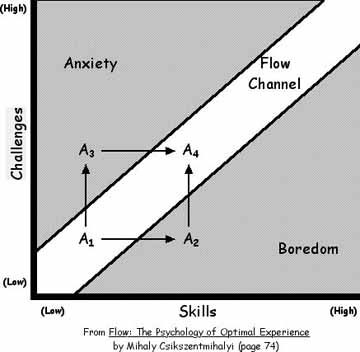
this onslaught [of twittering] is keeping us from doing the one thing that makes most of us the happiest... being in flow. Flow requires a depth of thinking and a focus of attention that all that context-switching prevents. Flow requires a challenging use of our knowledge and skills, and that's quite different from mindless tasks we can multitask (eating and watching tv, etc.) Flow means we need a certain amount of time to load our knowledge and skills into our brain RAM. And the more big or small interruptions we have, the less likely we are to ever get there.

And not only are we stopping ourselves from ever getting in flow, we're stopping ourselves from ever getting really good at something. From becoming experts. The brain scientists now tell us that becoming an expert is not a matter of being a prodigy, it's a matter of being able to focus.

Although this post was on Twitter, it applies also to mulitasking. The ability to focus one's attention is necessary both for acquiring expertise and for being in flow. The fact that youngsters like to multitask and that they can do it better than oldsters says little about well they learn while multitasking. And the research says otherwise.

Prensky does have some good ideas. From his website, he has apparently done well at creating computer games for learning. I think games are great for learning. If I had the money, I'd get him to create a game for my first-year composition course.

I don't doubt that there are differences between my generation and the digital generation. I also don't doubt that much of what is said about the digital native has been exaggerated to the level of myth.

Related posts:
The Myths of the Digital Generation, Part II
Myths of the Digital Generation Cont'd
Hype from the Media and from Web 2.0 Evangelists

Links to online readings on multitasking and other cognitive processes from the Brain, Cognition, and Action Laboratory: Projects

Links to other posts on the myth of "digital natives":
Digital Natives and Immigrants: A concept beyond its best before date
Digital Nativism, Digital Delusions, and Digital Deprivation

Source:

Fried, Carrie B. (in press). In-class laptop use and its effects on student learning. Computers and Education.

Marc Prensky reports on the NSBA Study on Online Behaviors. The report, "Creating & Connecting: Research and Guidelines on Online Social and Educational Networking", gives some welcome statistics on how students are using the Internet, showing that much of the concern on the dangers on online social networking is exaggerated. For me, another problem is the exaggerated hype on why schools and teachers aren't using web tools.

Prensky writes:

In general, schools (teachers and administrators) are deathly afraid of what I call “The Emerging Online Life of the Digital Native” because it is something they don’t understand.

On what evidence does Prensky base these claims: (1) that schools are "deathly afraid" and (2) they are afraid because they don't understand it. I can imagine some schools and teachers being nervous, but deathly afraid? And perhaps some don't understand it, but all of the schools who don't accept it don't understand it?

I can think of other reasons for not rushing to accept social networking apps. The main one is time. I have my students using blogs, wikis, and RSS now. And I've been wanting to start incorporating podcasts and videos. But to learn how to use them (some of my students do use them, which is great!) effectively in my classes, I just don't have the time: I have two papers to write on the front burner, two on the back burner, a new text for our composition courses that I have to study and figure out what changes are needed to incorporate it, committees to serve on, and a wife, son, and daughter who I want to spend time with. (I suppose I could stop blogging to find the time.) I imagine other teachers are just as busy, too, and they may simply be finding it difficult to find the time to to restructure and revise their teaching and keep up with their other tasks and responsibilities. Of course, some teachers, as Prensky notes, are likely stuck on "lecturing."

Prensky states:

A lot of concerns about the “have nots” would go away if the schools kept their computer labs open till midnight and on weekends, and teachers assigned projects to groups where at least one member (or the school) had the technology. Kids are great at sharing and teaching each other.

Now, I like this idea, but I wonder what would be involved and how much it would cost to do this. Most people already grumble about the taxes they pay now for schools. As a member of a school's board, I know that we couldn't cover the cost with our present budget.

Prensky has other good ideas, too. The exaggeration, however, is problematic: That is, those who don't listen to the Web 2.0 evangelists are in "darkness," as Prensky puts it, and those who heed the call will be in the "light" and go to education heaven.

Related posts:
Myths of the Digital Generation
Myths of the Digital Generation, Part II
Myths of the Digital Generation Cont'd

Links to online readings on multitasking and other cognitive processes from the Brain, Cognition, and Action Laboratory: Projects

Links to other posts on the myth of "digital natives":
Digital Natives and Immigrants: A concept beyond its best before date
Digital Nativism, Digital Delusions, and Digital Deprivation

At 43 Folders, there is a great video of then-14-year-old pianist Jennifer Lin playing, who also gives "her thoughts on flow and creativity" with respect to composing music. An excerpt of her process follows:

What I do first is, I make a lot of little musical ideas that you can just improvise here at the piano. I choose one of those to become the main theme, main melody. Once I choose my main theme, I have to decide out of all the styles of music, what style do I want. And this year I composed a romantic style. So for inspiration, I listened to Liszt, Tchaikovsky, and all the great romantic composers. Next I made the structure of the entire piece with my teachers. They helped me plan out the whole piece. The hard part is filling it in with musical ideas, because then you have to think. And then when the piece takes somewhat of a solidified form, you're supposed to actually polish the piece, polish the details, and then polish the overall performance of the composition.

And another thing I enjoy doing is drawing. Drawing because I like to draw Japanese anime art. And once I realized it, there's a parallel between creating music and creating art, because for your motive or your little initial idea for your drawing. It's your character. You want to decide, who do you want to draw, or if you want to draw an original character. And then you want to decide how you're going to draw that character. Like am I going to use one page, am I going to draw it on the computer, am I going to use a two-page spread like in a comic book for more grandiose effect. And then you have to do the initial sketch of the character, which is like your structure of a piece, and then you add pen and pencil and whatever details you need. That's polishing the drawing.

Lin noticed a similar process for composing music and drawing anime art. It makes sense to me that the process is similar for many activities, including writing.

The need for scaffolding
Lin is a prodigy. She started studying music with Yamaha at the age of four. So, by the time of this video, she had been studying music intensively for 10 years, achieving the status of an expert (see The Expert Mind). Yet, notice that even at her level of experience, knowledge, and skill, her teachers helped her "structure" and "plan out the whole piece." That approach is somewhat at odds with the expressionist school of writing which wants students to find their own voice from the beginning, and composition theory that prefers to be non-directive. (In practice, many, probably most, composition instructors scaffold students by teaching about strategies, invention, and other processes.) Note that Lin found her musical "voice" by listening to great composers. Similarly, chess enthusiasts study the games of the grandmasters.

The need for extensive reading
Lin's approach, a typical one in music and chess, suggests that students need to read great authors to find their voice, and to do so over a lengthy period of time. One obstacle in teaching writing, however, is that few students read extensively, much less read great authors extensively. Another is that for ESL writers, finding a voice means finding one acceptable to native English speakers, not a voice true to them and to their culture. There is no way to bypass this need. Lin's ability to "polish the piece, polish the details, and then polish the overall performance of the composition"--in writing, to revise the essay, edit the details, and then finetune the overall coherence of the composition--is directly related to her extensive background in music.

Bottleneck constraints on creativity and learning
Lin's approach also indicates that creativity stems from one's familiarity with one's discipline or content. One problem in teaching composition at the university level has been transfer. For a variety of reasons, what is learned in first-year composition doesn't seem to transfer well to later courses, especially in other disciplines. Part of that lack of transfer is due to a lack of discipline/content knowledge. In attempting to develop their writing, students face two hurdles, subject matter knowledge and writing knowledge, creating a bottleneck that constrains developing their writing. (On bottlenecks, see here and here and here.)

Suggestions in teaching writing
One consequence of a bottleneck perspective is that students learning to write should write on topics they know well. Of course, they should move beyond their personal knowledge and experience and research their topics. Even though Lin obviously knew the romantic composers, she immersed herself in their music again. Thus, students need to immerse themselves in the conversations, academic and popular, on their topic, so that the more they know the concepts and issues on a particular topic, the more they can focus on their writing.

Along these lines, students might write on (and continue to research) the same topic via a series of papers that will allow them to focus more on developing their writing. For instance, on any topic, papers might include:

  • a rhetorical analysis of posters, advertisements, or photos on the topic
  • a letter to the editor of a newspaper
  • a review of a book or film on the topic
  • a proposal to a concerned party to take action on the issue

Reading, analyzing, and writing in different genres can also help students to become more aware of rhetorical conventions as they see how the conventions vary across genre, audience, and context. And as with Lin's teachers, we need to "structure" how they fill in the details: introducing them to different strategies for developing their ideas and planning their composition, making academic conventions explicit (see They say / I say), and so on.

To sum up, developing one's writing, one's voice, one's creativity, is mostly a matter students of spending time on task, as Lin does. However, providing structure and reducing the bottleneck of subject matter knowledge can help students in this process.

Related posts
Engagement and FLow
Flow, Games, and Learning
Want to be creative? Slack off
Engagement, flow, and classroom activity
They Say / I Say
The Five-Paragraph Essay and Building Blocks of Writing

We're all familiar with the notion of first impressions and how the first day of class is crucial for setting the tone for the entire semester. But how does it work?

Primed by our senses
Part of the answer can be found in Benedict Carey's article "Who's Minding the Mind? (New York Times via Will Thalheimer), which reports on psychology experiments showing that people are primed by their senses:

The study participants, college students, had no idea that their social instincts were being deliberately manipulated. On the way to the laboratory, they had bumped into a laboratory assistant, who was holding textbooks, a clipboard, papers and a cup of hot or iced coffee — and asked for a hand with the cup.

That was all it took: The students who held a cup of iced coffee rated a hypothetical person they later read about as being much colder, less social and more selfish than did their fellow students, who had momentarily held a cup of hot java.

And the article gives quite a few more examples of how sounds, smells and sights can prime us, for instance:

In one 2004 experiment, psychologists led by Aaron Kay, then at Stanford University and now at the University of Waterloo, had students take part in a one-on-one investment game with another, unseen player.

Half the students played while sitting at a large table, at the other end of which was a briefcase and a black leather portfolio. These students were far stingier with their money than the others, who played in an identical room, but with a backpack on the table instead.

The mere presence of the briefcase, noticed but not consciously registered, generated business-related associations and expectations, the authors argue, leading the brain to run the most appropriate goal program: compete. The students had no sense of whether they had acted selfishly or generously.

More sensory hardwiring
We're hardwired by our senses in many ways, one of which is beauty. The "waist-hip ratio (WHR) is a significant factor in judging female attractiveness" (Wikipedia). Symmetry is apparently a factor in judging beauty, too, not only in humans but also in other species (Feng). "[A]ttractive scents - like the smell of freshly baked bread - are already known to keep customers in a store for longer (New Scientist). Music affects us, too. In one piece of research, it was shown that labeling wines with flags representing country of origin (France or Germany) and playing French accordion and German beer-hall music on alternating days affected sales:

"Despite an overall bias in favor of French over German wine sales," they soberly reported last week in the prestigious science journal Nature, "French wine outsold German wine when French music was being played, whereas German wine outsold French wine when German music was played." What may be even more significant is that only six of the 44 customers who consented to fill out a questionnaire admitted that they had been influenced by the music.

The Power of Precedent and Cultural Norms
Similarly, students subconsciously notice cues about the instructor, about their classmates, and about the general classroom environment that prime them to act in particular ways. Of course, later sense impressions can also have an effect, perhaps contrary to the earlier ones. However, once a group, such as students in a class, has established a precedent, or culture, for particular ways of acting or feeling about writing, that precedent has a strong effect on later actions.

In The Psychological Foundations of Culture, Holly Arrow and K.L. Burns look at how small groups establish behavioral norms. Using both complexity science and Alan Page Fiske's social relational models of culture (see Social Relations and Classroom Activity for a brief explanation) as a basis, they studied four groups of college students playing social poker. These groups, for different reasons, formed different norms in their groups. Once formed, however, those norms tend to stay in place, although they can be disrupted.

A combined authority ranking/communal sharing model was popular but persisted. The group stuck with this norm not because they were happy, but because dissatisfaction did not translate into coordinated action. The market pricing/communal sharing norm disappeared when a dissident dyad shook up the system.

In other words, it takes effort to oppose or change norms, once they've been established. Remember the Stanley Milgram and Stanford Prison experiments? Just as our senses prime our actions subconsciously, so do societal norms.

Practice
What does that mean in practice? At the minimum, we should work at becoming more aware of how all that we do--from our appearance to our habits and attitudes to our gender--affects our students and us. (See here and here and here and here.) Actually, we're quite aware when an occasion is important to us. Few of us wear less than business attire when in a job interview or in court (see, for example, Judging by Appearance).

Of course, as noted in Trout's satire, How to Improve your Teaching Evaluation without Improving your Teaching!", we could approach this in a manipulative manner. That's not the point. As Robert Rosenthal, Professor of Psychology, remarks in his biographical blurb:

For nearly half a century I have been fascinated by the psychology of interpersonal expectations; the idea that one person's expectation for the behavior of another can come to serve as self-fulfilling prophecy. Our experiments have been conducted in laboratories and in the field, and we have learned that when teachers have been led to expect better intellectual performance from their students they tend to get it. When coaches are led to expect better athletic performance from their athletes they tend to get it. When behavioral researchers are led to expect certain responses from their research participants they tend to get those responses. For almost as long as I've been interested in interpersonal expectations I've also been interested in various processes of nonverbal communication. In part, this interest developed when it became clear that the mediating mechanisms of interpersonal expectancy effects were to a large extent nonverbal. That is, when people expect more of those with whom they come in contact, they treat them differently nonverbally. Some of our most recent research on nonverbal behavior has examined "thin slices" of nonverbal behavior -- silent videos or tone-of-voice clips of about 30 seconds or less. Some of our more recent work with these thin slices shows that we can predict, using 30 seconds of instructors' nonverbal behavior, what end-of-term ratings college students will give their instructors. From thin slices of doctors' interactions with one set of patients, we can also predict which doctors are more likely to be sued by a different set of patients. Finally, jury verdicts can be predicted from the nonverbal behavior of the judges as they instruct the jury.

Similar to our senses instinctively priming our behavior, our nonverbal behavior reflects our (often unconscious) attitudes and expectations, which in turn, prime students' behavior and performance. We need to "mind our mind," to become more aware of our habits, attitudes, and expectations, from the first day of class on in order to help spark the intellectual performance that our students are capable of.

Baroness Susan Greenfield, the director of the Royal Institution and a professor of pharmacology at Oxford University, considers the notion of learning styles to be "a waste of valuable time and resources" (Julie Henry, Telegraph via Education News):

According to Susan Greenfield, however, the practice is "nonsense" from a neuroscientific point of view: "Humans have evolved to build a picture of the world through our senses working in unison, exploiting the immense interconnectivity that exists in the brain. It is when the senses are activated together - the sound of a voice is synchronisation with the movement of a person's lips - that brain cells fire more strongly than when stimuli are received apart.

"The rationale for employing Vak learning styles appears to be weak. After more than 30 years of educational research in to learning styles there is no independent evidence that Vak [visual, auditory, kinesthetic], or indeed any other learning style inventory, has any direct educational benefits."

Thirty years without independent evidence!

Commenting on student-centered learning about a year ago, I said that learning styles were not as important as the modality of the task:

When I began school more than a few years ago, I never "discovered [my] own learning styles." I still don't know what my learning style is. And it doesn't seem to have slowed me down as far as learning is concerned. When I think about the activities in which I engaged: studying various "book" subjects, taking Wood Shop, playing baritone horn in the band, and being on the wrestling team in high school, if there is such a thing as a learning style (at least in a way that it significantly affects learning), it seems obvious that the modality of the activity decides what "style" of learning should be employed.

As Greenfield states, "our senses [are] working in unison." A little bit of reflection confirms this: When playing baritone horn, I was using my ear for music, my eyes for reading music notation and watching the director, my fingers on the valves and lips on the mouthpiece for controlling the pitch, and my entire body for correct posture. And it didn't matter which of my "learning styles" I preferred. I had to use what was needed for the modality of playing music, in this case auditory, visual, and kinesthetic modalities working together.

Greenfield is not alone. Daniel Willingham, professor of cognitive psychology at the University of Virginia (American Educator), says,

What cognitive science has taught us is that children do differ in their abilities with different modalities, but teaching the child in his best modality doesn’t affect his educational achievement. What does matter is whether the child is taught in the content’s best modality. All students learn more when content drives the choice of modality.

Willingham's article is worth reading in its entirety, but two of his points are:

  1. Some memories are stored as visual and auditory representations—but most memories are stored in terms of meaning.
  2. The different visual, auditory, and meaning-based representations in our minds cannot serve as substitutes for one another.

They seem clear enough. Despite the pervasive belief in the effectiveness of teaching according to students' learning styles, there's too little, if any, evidence supporting it--not to mention that the most important variable in learning is "time on task" (see The Expert Mind). From a pedagogical perspective, it seems Greenfield is right: Learning styles is nonsense.

Update of related articles (via ict-echo):
Learning styles and pedagogy in post-16 learning : A systematic and critical review
Stephen Draper's "Learning Styles (Notes)"

The Online Education Database is an excellent resource for online learning. Yesterday, they posted "Take Any College Class for Free: 236 Open Courseware Collections, Podcasts, and Videos". This page also has a link to their Top 100 Open Courseware Projects, The Top 25 Web 2.0 Apps to Help You Learn, and The Top 25 Web 2.0 Apps to Help a Student's or Professor's Productivity.

About a year ago, Dave Lee at Learning Circuits Blog wrote on why the Help Desk and Customer Service in a company are the best at helping employees or customers learn. His reasons included:

  • generally don't teach courses
  • answer the questions their "learners" have at the time they are in greatest need
  • assess each situation and determine the best course of action to answer the learner's need
  • provide the learner with only the answers they need to overcome the current problems
  • have a database of answers to questions that have been asked before and will likely be asked again
  • have a mechanism for escalating the response when the learner's need is of greater breath than can be resolved immediately.
  • track very specific metrics regarding performance and learner response.
  • often have a follow-up mechanism to determine whether their solution to the learner's need is still working several weeks later and to gain feedback from the learner regarding their experience with the group
  • feed overall questions and needs back to the stakeholder groups who can take action regarding the issue to mitigate the same problem in the future.
  • gather feedback from their stakeholders regarding their effectiveness.
  • push as much of the process and answers pro-actively to their learners in the form of knowledge bases and FAQ as well as anticipatory actions like alerts and job aides.

Quite a few people disagreed with him, saying that many help desks weren't all that good. Even so, note that most of his reasons are associated directly, or indirectly, with feedback: answering questions, tracking performance and responses, follow-up mechanisms, stakeholder feedback (two-way). As noted in "Flow, Games, and Learning", feedback, especially when immediate, is a crucial element of obtaining a state of flow, of intrinsic motivation, especially when that feedback is immediate, or just in time.

Note also that the learners are actively participating in a meaningful process: asking questions, reading knowledge bases, using the information toward their immediate goals.

We could continue analyzing this list and seeing learning "best practices". Isn't it interesting that parts of a company can come up with "best practices" of learning without having studied educational theory? Might it be that business survival pressures can lead to learning systems that work? And when educational systems don't work, might it be that they don't have enough pressure to change. I'm not suggesting that schools should become businesses. Our purposes are different. Still, perhaps we can learn from business "best practices."

With respect to pressure, one difference between businesses and schools is that both the help desk and the customers have a more pressing need to learn than students do, and they have reasons for learning answers to specific questions that students don't have. Take introductory biology, for example. Have you ever used the Krebs electron cycle once in your daily life? At Work? Learning in school is not just-in-time necessary learning: It's learning for possibly (or probably not) necessary future endeavors.

The structure of school "learning" works against facilitating intrinsic motivation. Although re-structuring traditional schools is unlikely, one approach would follow Roger Shank's story-tellling curriculum:

The idea behind the Story-Centered Curriculum (SCC) is that a good curriculum should consist of a story in which students play a key role (for example, VP of Information Security at a financial services company). These roles are selected to be ones that the graduate of such a program might actually do in real life or might need to know about (because he or she will manage or collaborate with someone who performs that role). Students, working in groups, are given detailed information about the simulated company they are working for together with detailed and authentic projects. Supporting materials and resources are available and experts and online mentors are available to answer questions and point students in the right direction on an as-needed basis.

The effect of the SCC model is that as students work through the story to achieve the missions the story puts forth, they learn the critical skills they need to successfully accomplish their tasks. The SCC implements true learning-by-doing, integrating all aspects of real-world tasks, as opposed to teaching skills independently, without context.

Shank gives examples of how the SCC curriculum would work for an MBA program and even for high school:

The SCC is about the elimination of courses in favor of curricula that tell a meaningful story that the student is likely to engage in again after graduation. Now, many high school students are simply preparing for college, and thus one could argue that they take trigonometry in order to take college math. The fact that this isn't really true may not matter in this case. What is important is that we identify some stories that the student might want to live in high school because they may come up again. Here are some examples: running a small business, working on a political campaign, building a house, designing a city, running an organization, being a parent, creating an invention, making a discovery, convincing an organization to do things differently. Now, these are not normally thought of as courses in high school. However, looked at closely, they would entail calculating, planning, reasoning, dealing with societal issues, basic psychology, basic economics, dealing with historical issues, communicating in written and oral fashion, teamwork, research and nearly every other subject normally taught in high school (and quite a few that are not.)

Unlike traditional curricula, such a curriculum can have clear goals that give immediate and contextualized feedback on one's learning. To read more on the story-centered curriculum, see Shank's white paper Every curriculum tells a story (pdf).

So now I'm wondering how the SCC curriculum might be adapted for first-year composition. The problem is that the SCC curriculum is for programs not individual courses and Shank notes that not even all programs fit into an SCC curriculum because they don't have well-defined career goals. Generally speaking, first-year composition doesn't have career goals because it's a general education course designed to prepare students to write in more advanced classes and eventually in their widely disparate careers. So, I need to think about this a bit. If you have any ideas about turning composition courses into stories based on career goals, email me.

What do you think? Does one "learn" a language much like any other cognitive endeavor? Or is it "acquired" due to some innate language-specific biological mechanism?

There's quite a bit of controversy on this issue, on whether some universal grammar (UG) is responsible for language acquisition, deriving from an innate process specific for language. For those taking the UG approach, acquisition results from the UG module while "learning" is due to normal learning processes. Not all agree. For example, consider Christiansen and Chater's working paper, "Language as Shaped by the Brain". Here's the abstract:

It is widely assumed that human learning and the structure of human languages are intimately related. This relationship is frequently suggested to be rooted in a language-specific biological endowment, which encodes universal, but arbitrary, principles of language structure (a universal grammar or UG). How might such a UG have evolved? We argue that UG could not have arisen either by biological adaptation or non-adaptationist genetic processes. The resulting puzzle concerning the origin of UG we call the logical problem of language evolution. Because the processes of language change are much more rapid than processes of genetic change, language constitutes a “moving target” both over time and across different human populations, and hence cannot provide a stable environment to which UG genes could have adapted. We conclude that a biologically determined UG is not evolutionarily viable. Instead, the original motivation for UG--the mesh between learners and languages--arises because language has been shaped to fit the human brain, rather than vice versa. Following Darwin, we view language itself as a complex and interdependent “organism,” which evolves under selectional pressures from human learning and processing mechanisms. That is, languages are themselves undergoing severe selectional pressure from each generation of language users and learners. This suggests that apparently arbitrary aspects of linguistic structure may result from general learning and processing biases, independent of language. We illustrate how this framework can integrate evidence from different literatures and methodologies to explain core linguistic phenomena, including binding constraints, word order universals, and diachronic language change.

In brief, learning a language is like learning any other skill.

More recently, the National Institutes of Health released news on a six-year study on brain development in healthy children. The study followed the brain development of about 500 children, ages 6-18, each child being tracked over a four-year period. One finding (accompanied by caveats) undermines the notion of language being innate:

Children appear to approach adult levels of performance on many basic cognitive and motor skills by age 11 or 12, according to a new study coordinated by the National Institutes of Health (NIH). ...

Regardless of income or sex, children appeared to improve rapidly on many tasks between ages 6 and 10, with much less dramatic cognitive growth in adolescence. This result fits with previous research suggesting that in adolescence, there is a shift toward integrating what one knows rather than learning new basic skills.

In other words, there is a "critical period" for learning gen