writing

The Annual Meeting of the National Writing Project started today in San Antonio. I attended two three-hour sessions: "Writing in a Digital Age" and "The Web as a Tool for Continuity" (see below for presenters' names).

Writing in a Digital Age
looked at writing in digital environments with respect to building online classroom community, professional development, and teacher leadership via a combination of presentation, small-group discussion, and whole-group discussion on successes, failures, and open-ended questions, some of which were:

  • What are the implications for the design of your site’s professional development programs with technology?
  • What are the implications for developing technology leaders at your site?
  • How are professional development experiences affected by technology?
  • How can I engage diverse students who may or may not want to be in my classroom?
  • How can I help all students become better critical thinkers, researchers, and writers?

The Web as a Tool for Continuity
was a session of sharing, discussing, and troubleshooting problems of continuity of Teacher Consultants at writing project sites and ways in which technology can support continuity. Three questions that were discussed were:

  • How can you ensure that this work will stay integral to the site, and not be a distraction or a flash in the pan?
  • Who might be the key leaders of an Internet-enhanced continuity project at your site?
  • What capacity challenges or opportunities might such an initiative contain?

One of the failures of many sites has been trying to use blogs to provide continuity of leadership and professional development. They tend to wither as teachers leave the Summer Institutes to return to the classroom.

The Bay Area Writing Project took another tack and started an e-Zine, Digital Paper, which combines stories, pictures, and podcasts. It has had some success.

The strategy of the Alaska State Writing Consortium was to have an online Open Institute. In it, teachers examined their own work and built a framework for change via activities, such as:

  • audio-conferences
  • web-based posting of documents and data
  • online discussion
  • live chats
  • daily journals
  • discussions of readings

One interesting feature of this Institute was having an ethnographer who looked at the online communications and gave feedback back to the group on what s/he was seeing, noting concerns, noting areas of idea conflict, and so on. And at the end of the Institute, a lengthy report was written on what happened in the class.

As I look back over my notes, the key aspects of building communities seem to be

  • start with a group of 3 or 4 committed people who can share different responsibilities
  • start small projects that don't overwhelm you or participants
  • make it relevant to participants' immediate needs and goals
  • give participants' time to "play" with the technology
  • develop personal relationships with participants

These principles are not new, but it's easy to get carried away with visions of grandeur only to be let down when others don't see as you do. And these two sessions were excellent in terms of being practical, showing us their own applications of and twists on these principles, and of leading us into discussing and thinking about the implications of the presenters' own successes and failures for our own sites' future endeavors.

Presenters:
Writing in a Digital Age
Felicia George, New York City Writing Project
Sarah Hunt-Barron, Upstate Writing Project
Rebecca Kaminski, Upstate Writing Project
Seth Mitchell, University of Maine Writing Project
Jason Shiroff, Denver Writing Project
Laura Stokes, Inverness Research Associates

The Web as a Tool for Continuity
Sonnet Farrell, Alaska State Writing Consortium
Tom McKenna, Alaska State Writing Consortium
Evan Nichols, Bay Area Writing Project
Sondra Porter, Alaska State Writing Consortium
Carol Tateishi, Bay Area Writing Project

Bradley Hammer comments on the writing his students do at Duke University in A New Type of Writing Course, arguing that technology can make writing more meaningful to students:

In great contrast to only a few years ago, most of my students write several hours a day. I’m not talking about technically perfect papers, focused on grammar and the rules of structure. These students are tirelessly blogging, texting and responding to their peers in lengthy e-mail. And rather than dismiss this kind of writing as lacking in academic merit, I’ve started thinking about how schools can embrace, in academic ways, the emerging forms of writing students have already claimed as their own. ...

As part of this change, technology has radically extended the spaces for academic debate. In real ways, blogging and other forms of virtual debate actually foster the very types of intellectual exchange, analysis and argumentative writing that universities value.

Along these lines, Can MySpace make better writers talks about how technology is changing writing and how it can motivate students in their writing.

Amy Gahran, in Straight to the Point: The Miniskirt Theory of Writing (via Downes), asserts,

If you want to make a point in writing, make sure you nail the “so what” in your first 62 words.

Of course, as she admits, reader tastes vary and cites Dave Taylor as saying "more educated, intelligent readers prefer longer, more thoughtful and eloquent content." There's no question that the first words are important in "hooking" one's audience into continuing to read. But hopefully, one's posts will not become mere sound bites.

How Wikipedia Works: And How You Can Be a Part of It (via Downes) is an excellent online book written by Wikipedians Phoebe Ayers, Charles Matthews, and Ben Yates. It includes an appendix for teachers.

Blogging Pedagogy has a recent post on integrating multimedia into newspaper readings Deconstructing and Reconstructing Media and Messages:

For those of you looking to invite students to interact with different media, you might consider adopting and adapting the lesson plans conveniently provided as part of the Humanities Institute’s Living Newspaper Project. In this case, the four kinds of media are printed news reports, play script, oral reading, and theater performance.

What you can't win in court: "After you’ve been called racist by some students, can you sue to get your reputation back?" That's what Richard Peltz, who teaches law at the University of Arkansas at Little Rock, did. He began a lawsuit against students who had accused him of being racist because those accusations had led to him being "barred" from teaching certain courses. One of the accusations concerned his having students "focus more on their writing."

While defending his intent, Peltz pledged in his new memo to never again offer the writing tips “lest I again be maligned for trying to improve student writing.”

The article shows that it is not difficult to undermine the university as a place of learning and discussing ideas.

William Major, an associate professor of English at the University of Hartford, takes Another view of bias:

There’s a great deal of discussion in academe about a perceived bias amongst the professoriate, though Horowitz is looking in the wrong place. If he and his acolytes want bias, I have no doubt that there is plenty to go around. But playing favorites has the potential to do real harm to the student, ourselves, and to an ethic of professionalism. There is the spirit of fair play, unwritten and rarely acknowledged, through which we show our students and colleagues and, most importantly, ourselves who we are and what we are about. I suppose it’s called character.

Mark Richardson, an assistant professor of writing and linguistics at Georgia Southern University, takes aim at the myths surrouding learning to write in Writing is not just a basic skills:

From that vantage point, first-year composition is only indirectly preparatory to writing in other disciplines: What a student will learn is somewhat applicable to writing a history or psychology paper, but significant gaps in preparation will remain. Psychology professors who want students to write effective papers, even at the introductory level, can't count on first-year composition to have done all the preparatory work.

And here are a few more links on writing:
John Updike reflects on the challenges and satisfactions of the aging writer.
Zhura releases world's first online, collaborative editor for comic book writers
On college: Essay writing critical to getting accepted

Eighth and twelfth graders in New Jersey have the highest scores in writing on a nationwide test: 56 percent scoring at or above the proficient level, compared to one-third of eighth graders and one-fourth of twelfth-graders in the U.S. (see In Test, Few Students are Proficient Writers). And the university graduating the most teachers in New Jersey is Kean University. Of course, I can't say with certainty that Kean University is responsible for those writing scores, whether in part or otherwise, but such a correlation brings a certain amount of satisfaction in working in the Composition Program at Kean.

What is the value of a degree in literature, philosophy, or humanities?

Literature
Frankly, I enjoy literature because as a human being, stories stir my imagination. As Doris Lessing, in her 2007 Nobel Prize in Literature acceptance speech, stated,

The storyteller is deep inside every one of us. The story-maker is always with us. Let us suppose our world is ravaged by war, by the horrors that we all of us easily imagine. Let us suppose floods wash through our cities, the seas rise. But the storyteller will be there, for it is our imaginations which shape us, keep us, create us -for good and for ill. It is our stories that will recreate us, when we are torn, hurt, even destroyed. It is the storyteller, the dream-maker, the myth-maker, that is our phoenix, that represents us at our best, and at our most creative.

And, in addition, I would love to have a good understanding of the craft involved in great stories so that I could appreciate them better.

But that's not the same as justifying their study to an external audience (see Fish's "Will the Humanities Save Us?"). Yet various articles make the assertion for a practical application of a degree in English. For instance, So you want to study ... A master's in English (Liz Ford) is a series of interviews on people who chose to study English, including why they did.

One individual stated, "One employer said, 'We want people who can think outside the box.'" Well, I imagine that English majors can certainly think outside of science or business boxes, but I'm not sure what value one of Shakespeare's sonnets would have in engineering design or accounting procedures.

Another stated, "More so than any other subject, English gives you transferable skills. You learn to write and express yourself well and learn communication skills." To some degree, I buy into this. Even so, it's a well-known fact that writing in a one style doesn't transfer well to another. One study (Berkenkotter, Huckin, & Ackerman), for instance, showed the difficulty a doctoral student had in transferring his previous experience in writing (bachelor's and master's in education, along with an intensive eight week seminar on "The Writing Process: A Humanistic Perspective") into the field of rhetoric:

During his early months in the program ... An analysis of his papers reveals several months of confusion during whicdh his writing suffered from numerous stylistic problems: poor cohesion, disorganized paragraphs, lack of focus, inappropriate vocabulary.

One reason for the difficulty in writing transfer was

Nate is "wrestling with ideas" at the expense of organization and style

In other words, to write well, you need to know the content matter. In fact, although Nate did make progress, his

difficulties with cohesion and coherence persisted long after he gained a relative mastery over the material that he was studying in his courses

If this much difficulty occurred in transferring writing knowledge and skills from one social science discipline to another, imagine how much more difficulty will occur when transferring outside of the social sciences to business or the "hard" sciences.

Then, Why should anyone think that academic experience, regardless of discipline, would provide someone with good writing skills? Denis Dutton, Professor of Philosophy at the University of Canterbury, wrote an article entitled "Language Crimes: A Lesson in How Not to Write, Courtesy of the Professoriate",

Pick up an academic book, and there’s no reason to expect the writing to be graceful or elegant. Many factors attract people to the scholarly life, but an appealing prose style was never a requirement for the job.

Having spent the past 23 years editing a scholarly journal, Philosophy and Literature, I have come to know many lucid and lively academic writers. But for every superb stylist there are a hundred whose writing is no better than adequate — or just plain awful.

Yet, literature, as Lessing asserts, has a value in its stories. Stories may be the best way of learning. As Alicia Juarrero, a philosopher, asserts, understanding requires a hermeneutics that “provide[s] insight into and understanding of how something happened, that is, into its dynamics, background, and context” (p. 240), that is, stories (see Dynamics in action, Part III). The stories she speaks of, however, are not limited to literature but may take the nature of Shell Scenarios for managerial decision making or of Roger Shank's Socratic Arts, in which

students work through the story to achieve the missions the story puts forth, they learn the critical skills they need to successfully accomplish their tasks. The SCC implements true learning-by-doing, integrating all aspects of real-world tasks, as opposed to teaching skills independently, without context.

Philosophy
Daniel Drolet, reporting on Philosophy's Makeover (via Stephen Downes), quotes Jeff Noonan,

“Philosophy develops communication skills, the ability to organize complex materials, negotiate between different positions and tease out different problems,” says Jeff Noonan, head of the philosophy department at the University of Windsor. “An extraordinary range of jobs require those abilities.”

And according to Daniel Gervais, a professor of law,

There’s definitely a thirst in business for people who can think creatively, analytically and outside the box

Although I would instinctively think that learning to think systematically and logically should be of help in solving certain types of problems, I know too little of philosophy to evaluate its practical use. Yet, isn't this claim about creative thinking and thinking outside the box the same as claimed by English majors? And wouldn't it also be subject to the limitation of a lack of subject matter knowledge? Perkins and Salomon in Teaching for Transfer write,

While the basic skills of reading, writing, and arithmetic typically show transfer (for reasons to be discussed later), other sorts of knowledge and skill very often do not.

And philosophy would not seem to be a basic skill, although perhaps, as Perkins and Salomon note, certain skills such as "the role of evidence" and "general and important thinking strategies" may be applicable here. (See also The Expert Mind by Phillip Ross and Eklund's review of Heather Dykes' book Metaphysics and the Representational Fallacy via Stephen Downes.)

Humanities
In addition to critical thinking outside-the-box skills, many argue that humanities can give character. Stanley Fish naysays that as wishful thinking in Will the Humanities Save Us?

The premise of secular humanism (or of just old-fashioned humanism) is that the examples of action and thought portrayed in the enduring works of literature, philosophy and history can create in readers the desire to emulate them. Philip Sydney put it as well as anyone ever has when he asks (in “The Defense of Poesy,” 1595), “Who reads Aeneas carrying old Anchises on his back that wishes not it was his fortune to perform such an excellent act?” Thrill to this picture of filial piety in the Aeneid and you will yourself become devoted to your father. Admire the selfless act with which Sidney Carton ends his life in “A Tale of Two Cities” and you will be moved to prefer the happiness of others to your own. Watch with horror what happens to Faust and you will be less likely to sell your soul. Understand Kant’s categorical imperative and you will not impose restrictions on others that you would resist if they were imposed on you.

It’s a pretty idea, but there is no evidence to support it and a lot of evidence against it. If it were true, the most generous, patient, good-hearted and honest people on earth would be the members of literature and philosophy departments, who spend every waking hour with great books and great thoughts, and as someone who’s been there (for 45 years) I can tell you it just isn’t so. Teachers and students of literature and philosophy don’t learn how to be good and wise; they learn how to analyze literary effects and to distinguish between different accounts of the foundations of knowledge. The texts Kronman recommends are, as he says, concerned with the meaning of life; those who study them, however, come away not with a life made newly meaningful, but with a disciplinary knowledge newly enlarged.

And Fish's position is backed up by studies in character education. Lawrence Kohlberg found that reasoning was necessary for moral judgment, and moral judgment for moral action, but moral reasoning and judgment were not sufficient for moral behavior. That is, one may be able to judge a situation correctly in terms of moral principles and still not take moral action.

Although Fish concludes that there is no practical "use" to the humanities, I'm more inclined to give the benefit of the doubt to philosophy, as far as transfer of critical thinking goes. And although the evidence for transfer of thinking skills with respect to literature would not seem to be on the same level as philosophy, with Lessing, its stories can instill a "fire" within us that has its own value and without which we might not be human. In fact, along the lines of Juarrero and informed by literature, I would redesign, as much as possible, curricula to be great stories.

Offline references
Berkenkotter, C., T. N. Huckin, & J. Ackerman (1998). Conventions, conversations, and the writer: Case study of a student in a rhetoric Ph.D. program. Research in the Teaching of English, 22, 9-44.

Juarrero, A. (2002). Dynamics in Action: Intentional Behavior as a Complex System. Cambridge, MA: The MIT Press.

Kohlberg, L. (1999). The cognitive-developmental approach to moral education." In A. C. Ornstein and L. S. Behar-Horenstein, eds., Contemporary Issues in Curriculum, 4th ed. (pp. 163-75). Boston: Allyn and Bacon.

iTunes University continues to grow. According to Apple's website, it has

over 75,000 educational audio and video files from top universities, museums and public media organizations from around the world.

Its latest addition is Edutopia: What Works in Public Education sponsored by the George Lucas Educational Foundation with podcasts ranging from Technology Integration to Assessment to Project Learning and more.

It also a variety of language learning podcasts, a few of which are Greek, Hebrew, Chinese, Japanese, ... , and, of course, English.

And it has various podcasts on writing, including podcasts from

Related post:
The Web: The Future of Learning

The 12th Spillman Symposium on Issues in Teaching Writing will have as its theme “Reading to Write: What, When, Where, and Why?” and speakers will include Professors David Jolliffe (U of Arkansas), Deborah Holdstein (Columbia College Chicago), and Eli Goldblatt (Temple U), who will initiate discussion of a topic inspired by Jolliffe’s recent College English article, “Texts of Our Institutional Lives: Studying the ‘Reading Transition’ from High School to College: What Are Our Students Reading and Why?”

Hosted by the Writing Program at Virginia Military Institute,

The Spilman Symposium on Issues in Teaching Writing is a one-day, annual event created to bring teachers of writing together for conversations with some of the major scholars in rhetoric and composition studies. Providing a forum for active engagement of timely issues, the symposium is designed as a think-tank for all instructors who are interested in the teaching of writing, including those involved with writing across the curriculum. Each year registration is limited to approximately sixty participants.

I've attended four of these symposiums in the last six years, and I can say that they are excellent for those who are interested in issues in teaching writing. Although it is not focused on second language writing, I always learn something useful in teaching writing.

Paul Kei Matsuda has recently set up Symposium for Second Language Writing Interactive. Here's some information from the site:

The purpose of SSLW Interactive is to provide a centralized resource portal for second language writing teachers and researchers from around the world. Currently, SSLW interactive provides the following features:

Blogs. Any registered user can create blog entries to share their experience and perspectives on various issues related to second language writing.

Groups. The site hosts group space for various related groups, including: TESOL Second Language Writing Interest Sections (SLWIS); CCCC Committee on Second Language Writing; CCCC Special Interest Group on Second Language Writing; Symposium on Second Language Writing; and Journal of Second Language Writing, among others.

Forums. Forums provide a space for the discussion of various topics related to second language writing in the traditional, hierarchical list format.

E-lists. A list of email lists related to second language writing. Recent contents are available from this site. Links to subscription information and list archives are also available. If you are aware of any other email lists, please post the description. (Anyone can add an edit the descriptions--you don't have to be the list owner to contribute!)

Conferences. A list of conferences, workshops and other meetings related to second language writing. If you are planning an event that may be relevant to second language writing teachers and researchers, please feel free to add an event.

Journals. A directory of journals that publish articles on second language writing. Please contribute by posting information about your favorite journal. (Anyone can add and edit the descriptions--you don't have to be the editor or the publisher to contribute!)

Programs. A directory of doctoral programs where students can specialize in second language writing. Please post information about programs you are familiar with. (Anyone can add and edit the descriptions--you don't have to be a faculty member or program director to contribute!)

CFPs. A list of call for papers/proposals related to second language writing.

SSLW. Information about the Symposium on Second Language Writing, an annual international gathering of second language writing specialists.

The site is in its infancy now, but it has the potential to become the central interactive clearlnghouse for all things related to second lnaguage writing. That potential, of course, is waiting for your contribution.

Participation Inequality

Most people are lurkers. Jakob Nielsen, writing on participation inequality, states:

  • 90% of users are lurkers (i.e., read or observe, but don't contribute).
  • 9% of users contribute from time to time, but other priorities dominate their time.
  • 1% of users participate a lot and account for most contributions: it can seem as if they don't have lives because they often post just minutes after whatever event they're commenting on occurs.

These percentages vary somewhat according to type of site (see Quantitative Analysis of User-Generated Content on the Web by Ochoa and Duval via Robert Hughes). Nielsen notes,

Blogs have even worse participation inequality than is evident in the 90-9-1 rule that characterizes most online communities. With blogs, the rule is more like 95-5-0.1.

Participation inequality is a fact of life. Suw Carman adds that in and of itself, is not a problem.

Still, it is possible to decrease the number of lurkers a little by making it easier for them to participate. Conversely, of course, the percentage of lurkers is likely to increase as the difficulty to contribute increases. In the case of trackbacks, as posting on one's own website requires more time than simply rushing off an "I agree" comment, the number of trackbacks will be smaller as they are more difficult than commenting. Looking at EFL Geek's statistics (before his new redesign), we see that he had written 1007 posts, received 1924 comments, 50 trackbacks, and 184 members. These statistics support the previous post's speculation that trackbacks took too much energy for people to use as compared to commenting.

Comments are Uninteresting

On enabling comments, Nielsen writes,

I would say to only allow comments if you have the time to moderate them. Otherwise, your site will suffer information pollution and waste readers' time because of the dominance of uninteresting comments.

I don't imagine that this site would ever have so many comments as to require much time to moderate them, but as, he notes, most comments are just "uninteresting." However, that assertion also has qualifiers. In analyzing the collaborative nature of the Web, he compares chat and discussion forums, writing that although most discussion forum posting are "uninteresting,"

the longer postings [in discussion forums] typically lead people to include some arguments and not just pure name-calling [compared to chat rooms]

This is in line with my earlier posts concerning commenting. In Monologic and Empty Comments vs. Parallel Conversations, I looked at comments on the sites of two well-known bloggers:

When I counted, out of the 58 comments on Brogan's post, perhaps 20% of them said something that added "content." Out of the 141 on Arrington's (not including trackback, which have a higher percentage of "content"), it seemed to be a little more than 20%. (I stopped counting quickly as my eyes glazed over.) Now, a few of the 20% were very good. Still, most comments were simply thanks, pats on the back, or repetition of something already said, without reference to others in the "conversation."

Learning from comments like these, which are fairly normal, is about as easy as learning in a room full of speakers, each with a megaphone shouting out their own opinion.

Generating Quality Comments

The exceptions to these types of comments tend to be found on blogs like that of the Becker-Posner Blog. The more serious the tone, the more knowledgeable the article, the more specific the focus of the blog the more specific, knowledgeable, and serious the responses will be. As mentioned two years ago in Rethinking Comments and Trackbacks, comments differed quite a bit, depending on the blog:

Over at weblogg-ed, I looked at the first 30 comments. The overwhelming majority of comments were in agreement with Will's position, sometimes adding a twist on it, but mostly agreeing.

At Creating Passionate Users, we see a different picture on one post, "Intuition", which had 15 comments when I looked at it. Three comments added nothing, but the majority added some point that was slightly new or gave a different perspective.

At "Half an Hour," Stephen Downes writes about "Adults and MySpace". It's a long article: 1758 words. It has two comments, one with 78 words that doesn't add much, and another with 280 words that adds new insight into the issue of adults on MySpace.

So, quality comments are possible, depending on the quality of the post. One other factor in getting quality comments is your responses to commenters. Referring to business, Nielsen writes,

Promote quality contributors. If you display all contributions equally, then people who post only when they have something important to say will be drowned out by the torrent of material from the hyperactive 1%. Instead, give extra prominence to good contributions and to contributions from people who've proven their value

Applying that to education blogs, respond in kind to comments that add some new insight into the topic at hand, and ignore those that add nothing.

Learning through Comments

For our students, Mary Hillis has a suggestion:

After the first week of the Book and Literature Circle Blog, I found that students wrote short comments, and there was no flow between contributions in the comment area. During the second week (this week), I specifically asked students to think about how they could connect their comments to previous ones and build up a conversation.

Thinking about participating in academic discussions, and synthesizing sources in academic writing assignments, I think that by challenging students to make connections between their comments and their classmates' comments, they are learning a valuable communication skill that they may be able to apply to other types of assignments.

This approach fits in well with Graff and Birkenstein's book They Say / I say, which

shows how academic argument is a dialogue in which an individual acknowledges what others are saying and at the same time makes a space for what s/he is saying.

As Mary noted in her other post on comments,

commenting is a skill that students need some guidance on

So, along the lines of making connections and synthesizing, I would help the students consider how to remix their comments and those of others (and of course giving credit appropriately) with the goal of coming up with new insights into the issue at hand. Perhaps, in this way, good comments can be generated, and learning might take place.

Abstract is better than concrete for transfer, according to the New York Times reporting of recent research in mathematics:

In the experiment, the college students learned a simple but unfamiliar mathematical system, essentially a set of rules. Some learned the system through purely abstract symbols, and others learned it through concrete examples like combining liquids in measuring cups and tennis balls in a container.

Then the students were tested on a different situation — what they were told was a children’s game — that used the same math. “We told students you can use the knowledge you just acquired to figure out these rules of the game,” Dr. Kaminski said.

The students who learned the math abstractly did well with figuring out the rules of the game. Those who had learned through examples using measuring cups or tennis balls performed little better than might be expected if they were simply guessing. Students who were presented the abstract symbols after the concrete examples did better than those who learned only through cups or balls, but not as well as those who learned only the abstract symbols.

The problem with the real-world examples, Dr. Kaminski said, was that they obscured the underlying math, and students were not able to transfer their knowledge to new problems.

“They tend to remember the superficial, the two trains passing in the night,” Dr. Kaminski said. “It’s really a problem of our attention getting pulled to superficial information.”

The explanation of examples clouding up the concepts reminds me somewhat of the research on reading about seductive details diminishing recall of information. (There are many articles on this phenomenon, but see, for example, Processing and recall of seductive details in scientific text.)

Transfer is also a major problem in writing: Students often don't transfer what they know about writing in one situation to new situations. Somehow, the situations are compartmentalized so that the concepts don't transfer, which remains me of the research on students learning physics. David Hammer's research showed that students could compartmentalize and keep their every day notions about motion from the physics concepts they were learning.

So, although this was a small study (and one that needs to be replicated), it does fit in with what we know of transfer, that learning that is bound to a particular context doesn't transfer well--which explains why students who have learned the five-paragraph essay structure in high school continue to use it in college even when an assignment requires them not to.

What would be the abstract set of rules for writing? I've looked at that before, except I called them "building blocks." But although I can see the need for knowing the building blocks abstractly, I think mastering them abstractly is achieved through much practice of remixing these building blocks across contexts. (See Learning by Remixing and also this review/synopsis of Spiro's Cognitive Flexibility Theory.)

The problem remains determining what those building blocks are. Although they likely differ across genre (just as math concepts differ from geometry to algebra to calculus and so on), they must also have elements in common. At a basic level, there's always writer, audience, text, and purpose. For persuasion, it may come down to the formula in Graff and Birkenstein's book "They Say / I Say", in which writers join into a conversation with others and position themselves with respect to those others. It's a small book with three parts and ten chapters:

Part 1. "They say"

ONE: "They say" (Starting with What Others Are Saying)

TWO: "Her Point Is" (The Art of Summarizing)

THREE: "As He Himself Puts It" (The Art of Quoting)

Part 2. "I Say"

FOUR: "Yes / No / Okay, But" (Three Ways to Respond)

FIVE: "And Yet" (Distinguishing What You Say from What They Say)

SIX: "Skeptics May Object" (Planting a Naysayer in Your Text)

SEVEN: "So What? Who Cares?" (Saying Why It Matters)

Part 3: Tying It All Together

EIGHT: "As a Result" (Connecting the Parts)

NINE: "Ain't So / Is Not" (Academic Writing Doesn't Mean Setting Aside Your Own Voice)

TEN: "In Other Words" (The Art of Metacommentary)

As you can see, despite having only two building blocks--"they say" and "I say"--students are led into a variety of ways of analyzing, synthesizing, and evaluating what "they say," along with generating their own understanding and position among others in a conversation. And treating persuasive writing like a conversation has many connections to students' lives: They argue about their sports, clothes, cars, majors, professors, and so on.

I imagine that different sets of building blocks are possible, just as different sets of rules can be found in different fields of math. The key seems to be helping students practice using one coherent set of building blocks (i.e., abstract principles) across contexts.

Related posts:
The Five-Paragraph Essay and Building Blocks of Writing
The Five-Paragraph Essay (continued)
Learning by Remixing

The 42nd Annual TESOL Conference (2008) is coming up soon, April 2-5, in New York City. Thursday afternoon, I'll be presenting along with three others on assessing writing . If you're coming to the conference and interested in assessing writing, here's a breakdown of what we'll be talking about.

Self-assessment
I'll be looking at how to help students in higher education learn to evaluate their writing, reflect on their writing, and take appropriate measures to improve their writing by

  • embedding assessment in the course objectives,
  • providing transparency in evaluative criteria, and
  • considering both product and process.

Basically, having students use the instructor's criteria for assessment gets them thinking in those terms, seeing more clearly course expectations, and hopefully giving them an understanding of assessment they can take with them after leaving our classrooms.

Multi-trait rubrics
John Liang will review a multi-trait rubric that assesses basic academic writing skills of incoming international graduate students in an MA TESOL program. Based on previous years’ assessment results, the rubric focuses on select component skills of academic writing (ability to comprehend the prompt, development of the argument, organization, grammar skills) instead of overall academic writing proficiency.

Techniques of assessment
Tim Grove provides a survey of techniques used to assess writing, including methods that minimize grading time, while remaining valid and reliable. He will examine rubrics, general comment sheets, error counting, error classification, personalized grading plans, Grade Negotiation, and even Rapaport’s “Triage Theory of Grading.”

Online and holistic assessment
Tim Collins will review strengths and weaknesses of online and holistic assessment of writing, now frequently used on high-stakes assessments, and provide ideas on how instructors can prepare learners for success on these assessments.

In all of these, we make certain assumptions. Assessment

  • should reflect objectives,
  • be transparent to students,
  • be fair and effective,
  • provide feedback to students and teachers, and
  • enable learners to self-assess and take responsibility for their learning.

As I mentioned two weeks ago, I had to set up a website for the Kean University Writing Project, which I've done. For now, I took the easy path using Sandvox, a nifty website creator, and the Franchise theme from Sandvox Web Designs. It's just a matter of copy and paste the information needed into the pages, sometimes with a little tweaking of the html code, and the program and template make it look good.

I was thinking, Did I learn anything from using this program? Do I need always to learn something in all endeavors? To both questions, I've come to the conclusion: No. Although I would enjoy learning more about html and css, spending too much time there would stop me from learning more about what I need to do as a technology liaison between our local site and the National Writing Project. It would take time away from learning about e-Anthology, how to introduce technology to the participants in the Summer Institute, and so on. Just like everything else in life, there are priorities of learning.

Michael Shaughnessy (Ednews.org) interviews E.D. Hirsch on school choice and the Core Knowledge Curriculum, and they discussed an article by Sol Stern and reactions to that article by E.D. Hirsch and others such as Jay P. Greene, Diane Ravitch, Neal McCluskey, Matthew Ladner, Thomas W. Carroll, Andrew J. Coulson and Robert Enlow. Here are two excerpts from the interview:

Critical thinking skills cannot be learned in the abstract.They always pertain to concrete knowledge of subject matter.I review the scientific literature on this in The Schools We Need.Writing skills are obverse of reading skills.They both depend more on knowledge of the unspoken within the language community than on knowledge of the spoken.The main, somewhat revolutionary point I have been making is that teaching content is teaching skills, where as teaching formal processes is, in the end, teaching neither content nor skills.This is not only clear in the scientific literature, it is also clear from comparative results.Students who have had been taught coherent knowledge are more highly skilled than those who have been taught "skills."See the (unfortunately repressed) book by the late Jeanne Chall: The Academic Achievement Challenge

The state standards in language arts (where students spend most of their time in early grades) are empty of content.It's all process.They are not standards at all in a meaningful sense.And they cause reading tests to be hugely unfair, because the topics in passages on reading tests always assume content knowledge that has not been taught in the schools.

This makes sense to me. Just try reading a treatise on quantum mechanics. Without a strong background in physics, any previous critical thinking skills you've acquired will be useless in interpreting this text.

This is one of the problems in many first-year composition programs: They teach the process of writing with limited content knowledge. Usually, students will choose one issue for, say, a definition paper, then another topic for an evaluative argument, and so on. Moving from content area to content area shortchanges students' ability to master process skills, as they must learn two areas: content knowledge and skills.

A better approach is to have students stay with one issue of their own interest the entire semester. In that way, they'll build their content knowledge, so that as the semester continues, they can begin to pay more attention to the critical thinking and writing skills associated with that domain. I noticed the Department of Rhetoric & Composition at UT Austin seems to be doing that now in First-Year Writing.

Of course, there's still the question of whether the writing skills they've learned will transfer to other courses not pertaining to those issues. My guess is they will have some chance of transferring, because the knowledge required in introductory courses is "introductory", unlike the knowledge in the example on quantum mechanics, meaning also that the skills acquired should be more general in nature. Testing that guess would make a good research project.

There's a great new writing resource hosted by McGraw-Hill (requires free registration): Teaching English: The Instructor's Resource Portal.

One thing I like about it is the teaching topics. I imagine they'll expand this section but right now they have five topics:

  • Plagiarism and using sources
  • Evaluating student work
  • Responding to student papers
  • Peer response
  • Writing with computers

Each of these topics, besides introducing the topic, covers the following:

  • Background of its respective research and theories
  • Instructional strategies
  • FAQ
  • Resources
  • Bibliography

I took a glance at them, and they'll concisely thorough. I'll be going back to look at them more closely.

Another appealing section is the two blogs. Right now there are two: Teaching Composition and Teaching Basic Writing. Teaching Composition focuses on first-year college composition. These blogs already have about 1 1/2 years of archives, as they are taking the place of their former email lists that used to discuss these particular entries.

This site is going to be a staple in my reading. It's worth it.

Below are links to articles on using comic books in school and to online comic book applications.

Comic Books in the Classroom (NY Times) reports on the Comic Book Project at Teachers College, Columbia University, which helps students become more interested in art and writing.

Teachers are finding it easier to teach writing, grammar and punctuation with material that students are fully invested in. And it turns out that comic books have other built-in advantages. The pairing of visual and written plotlines that they rely on appear to be especially helpful to struggling readers. No one is suggesting that comic books should substitute for traditional books or for standard reading and composition lessons. Teachers who would once have dismissed comics out of hand are learning to exploit a genre that clearly has a powerful hold on young minds. They are using what works.

Thinking outside the box, inside the panel (Valerie Strauss, Washington Post) also reports on the Comic Book Project. The project's founder, Michael Bitz,

wanted to combine his research findings -- that learning through the arts can have academic and social value for children -- with a creative approach to get kids to combine skills such as reading, writing, brainstorming and conceptualizing ideas. Creating comic books, he said, would allow them to draw on their experiences and interests.

Interview with Michael Bitz of the Comic Book Project (Christian Hill, National Association of Comics Art Educators).

Teachers are getting graphic (Greg Toppo, USA Today) is a lengthy article on those using comic books in public schools with a section on those not in favor. Those in favor feel that getting students interested in reading comics will lead to their wanting to read more serious books.

Even French philosopher Jean-Paul Sartre loved comic books, Gantos says. "This is a pretty heavy thinker, but he said in his autobiography that he started off reading comic books as a child and that if it wasn't for comic books, he never would have stuck with books.

Comic Book Project proves to be effective learning tool is a news release on The Maryland Comic Book Initiative.

Comics in the Classroom is a site devoted to using comics in school and has lesson plans, news, and reviews, all pertaining to using comic books.

Read-Write-Think is a site that has an online comic creator with accompanying lesson plans for using the tools.

curiosity

Tales from the Public Domain: Bound by Law? is a comic book from the Duke School of Law for teaching about copyright:

“Bound by Law translates law into plain English and abstract ideas into ‘visual metaphors.’ So the comic's heroine, Akiko, brandishes a laser gun as she fends off a cyclopean 'Rights Monster' - all the while learning copyright law basics, including the line between fair use and copyright infringement.” -Brandt Goldstein, The Wall Street Journal online

Heroes in the Classroom: Comic Books in Art Education (Jay Berkowitz and Todd Packer) is a 7-page JSTOR article (published in Art Education) that gives "background, guidelines, and a lesson plan to help you use comics and cartoons in these artistic skills of students."

For those with access, Bitz has a journal article on the Comic Book Project (see excerpt below):
Bitz, M. (2004). The Comic Book Project: Forging alternative pathways to literacy. Journal of Adolescent & Adult Literacy, 47.

In this arts-based literacy initiative in urban after-school environments, children brainstormed, outlined, sketched, wrote, and designed original comic books that represented their lives as urban youth.

Many deep-rooted problems in urban areas of the United States--including crime, poverty, and poor health--correlate with illiteracy. The statistics reported by organizations such as the National Alliance for Urban Literacy Coalitions are telling. Urban citizens who cannot read sufficiently are at a clear disadvantage in life. They are more likely to be poor (see Barton & Jenkins, 1995), to be incarcerated (see Haigler, Harlow, O'Connor, & Campbell, 1994), and to have health problems (see Baker et al., 2002). Meanwhile, another body of research shows a strong correlation between arts-rich environments and children's academic performance (Burton, Horowitz, & Abeles, 1999). Of course, the jury is still out on the conundrum between the chicken and the egg: Do the arts make kids smarter, or are smart kids involved in the arts?

While the debate continues in the academic community, the fact remains that most urban schools are not "rich" in arts or anything else. Most urban schools cannot make a connection between their arts and academic programs be cause there are simply too many other issues to worry about, particularly budgets and standardized test scores. Even in an arts-oriented program, urban youth face extraordinary challenges: family situations, safety concerns, lack of affordable or appropriate instructional opportunities, and peer resentment (Oreck, Baum, & McCartney, 1999). As urban schools continue to struggle, many now look to after-school programs as the future of education in the city. The need for and development of after-school programs are on the rise, and many...

Links to online tools for making comics:
Make Beliefs Comix
Comics Sketch
Strip Generator
Strip Creator
ToonDoos

How many times have you heard the notion that school learning isn't related to the "real world"? Or perhaps that university essay writing isn't authentic?

Well, today,as a member of the board for Paterson Charter School for Science & Technology, I attended EIRC training for observing and evaluating administrative staff: the board's responsibility in doing so, creating instruments and criteria for doing so, following those criteria, and documenting all evaluation. The evaluation itself should be in the form of a narrative report (that is, an essay) with the following elements:

  • Claims - generalizations
  • Evidence - backs up the claims
  • Interpretation - explains the evidence
  • Evaluation - thoughts of the evaluator [on what actions should be taken]

Those four elements correspond to my own teaching in first-year composition. That is, I teach that all body paragraphs have the elements of claims, evidence, and reasoning/analysis (explaining how the evidence supports the claims). The evaluation usually comes in the conclusion.

For an example from today's New York Times, we can look at the article "Gospel Truth" by April DeConick, professor and historian of early jewish and Christian thought at Rice University (see her Forbidden Gospels Blog"). In her op-ed piece, she is arguing that the National Geographic Society's translation of the "Gospel of Judas Iscariot" has serious errors. Here's one excerpt:

Whoever wrote the Gospel of Judas was a harsh critic of mainstream Christianity and its rituals. Because Judas is a demon working for Ialdabaoth, the author believed, when Judas sacrifices Jesus he does so to the demons, not to the supreme God. This mocks mainstream Christians’ belief in the atoning value of Jesus’ death and in the effectiveness of the Eucharist.

The second sentence is evidence, and the third sentence interprets that evidence. The first sentence, a claim is an interpretation of the third sentence, a more generalized interpretation of the evidence, or a more general claim concerning the evidence. Let's look at one more excerpt:

Several of the translation choices made by the society’s scholars fall well outside the commonly accepted practices in the field. For example, in one instance the National Geographic transcription refers to Judas as a “daimon,” which the society’s experts have translated as “spirit.” Actually, the universally accepted word for “spirit” is “pneuma ” — in Gnostic literature “daimon” is always taken to mean “demon.”

Again, the second sentence is evidence, but so is the third sentence. So, the first sentence is an interpretive claim concerning the evidence.

Thus, depending on how clearly and directly the evidence supports the paragraph's main claim (and depending on the audience), other interpretive sub-claims may or may not be necessary.

Where's the evaluation? In the second-to-last paragraph:

To avoid this, the Society of Biblical Literature passed a resolution in 1991 holding that, if the condition of the written manuscript requires that access be restricted, a facsimile reproduction should be the first order of business. It’s a shame that National Geographic, and its group of scholars, did not follow this sensible injunction.

In other words, DeConick is recommending that scholars follow the resolution. So, whether in evaluating school administrators, crafting opinion pieces in the New York Times, or writing essays in first-year composition, the elements of argument--claims, evidence, interpretation, and evaluation--exist. So, it seems that school writing does have some authenticity.

Don't you hate it when you end up in the wrong room? I wanted to go to the "New York Showcase," which would look at social networking, blogs, wikis, and podcasting to support reading and writing, but I ended up in an authors' strand session featuring Holly Black and Linda Sue Park, writers of children's books. But sometimes a mistake proves to be serendipitous.

These two authors talked about their books, and they also talked about universal themes in stories. In fact, Park says there are two universal themes:

  • hero goes on a journey
  • stranger comes to town

In addition, stories follow a certain sequence of actions:

  • At the beginning of every story, a change of state occurs: Something goes wrong.
  • The resulting need or struggle propels the story
  • The conclusion arises when there is another change of state, sometimes one of reaching one's goal, sometimes not.

Identifying these common themes and actions can help students identify them across stories and can help them in writing their own stories.

Next, for a practical classroom example of using these generic themes and actions, Holly led us in a re-making of Cinderella. That is, she asked the questions, and we provided the answers. It went something (I didn't follow all of it) like this:

Once upon a time, there were two struggling young authors who lived in New York City who had a young son named Harold.

One of the parents died and the other remarried to an evil stepfather with his own evil children.

The young lad dreamed of becoming a comic book writer.

Eventually a teacher (the fairy godmother) came to the lad's rescue, bringing his drawings to the attention of an editor (i.e., the prince).

However, the evil stepbrother took credit for his drawings.

So, the editor created a contest so that the one who could draw like the drawings he had seen was the true comic book writer and would receive a publishing contract.

Finally, the good son demonstrated his talent, got the contract, and lived happily ever after.

Again, Holly asked the questions, providing the necessary structure to lead us through our own creating of details and coming to a better understanding of the Cinderella genre.

One other interesting genre described was sijo Korean poetry. In one way it's like haiku: It has three lines, each with a limited range of syllables. (Due to the long length across the page, the three lines can be split into six lines, with the same number of syllables for each two lines.) But it's also different. First the number of syllables ranges from 14-16, much longer than a haiku line. The second is that it is more formulaic. The first line is an introduction; the second gives more details, and the third line provides an unexpected twist. Here's an example:

BREAKFAST

For this meal, people like what they like, the same every morning.
Toast and coffee. Bagel and juice. Cornflakes and milk in a white bowl.

Or--warm, soft, and delicious--a few extra minutes in bed.

Writing poetry with a twist at the end should be interesting to children, and it may be useful for older students in getting them to use their imagination to think out of the box by coming up with a twist at the end.

What sort of web presence should you or your organization have? And how do you go about creating it?

These questions and others were discussed at a session at the 2007 NWP (National Writing Profect) 2007 Annual Meeting this morning. The session on "Planning your site's online presence" led by Susan Biggs, Cheryl Canada, and Terri Godby, had us look at the following items:

  • Inquiry questions
  • Web presence word explosion
  • Exploring identity
  • Exploring audience and purpose
  • Mapping out our writing project sites

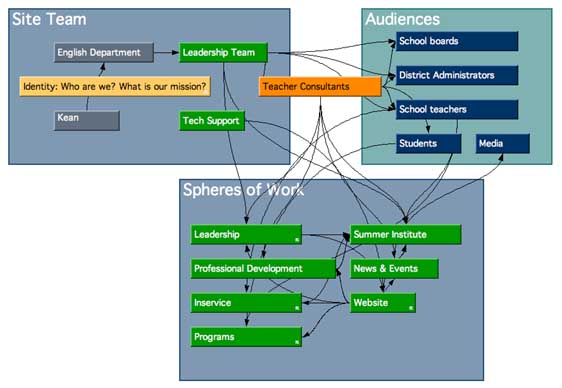
The main point was to establish our identity: who we are, what we do, and who do we have relationships with. And to do so in a way that was clear, professional, relevant to teachers' and schools' needs, welcoming to visitors and potential participants, and accessible in terms of ease of use and navigation. I made a preliminary map as follows:

One crucial relationship, as represented in the figure, are the teacher consultants who are on the leadership team and also take back to their schools and fellow teachers what they have learned in the Summer Institute and other programs. Yet as the connecting lines indicate, to have a web presence that represents you well takes considerable interaction and collaboration among the different participants.

To see how three local sites have interpreted these issues, check out
Western Masschusetts Writing Project
The Philadelphia Writing Project
Northern Virginia Writing Project

The second speaker at the Spilman Symposium was Edward White, professor of English at the University of Arizona. I have one of his books, Assigning, Responding, Evaluating, and it's an excellent guide for, as the title says, assigning, responding to, and evaluating writing. White talked on "Why write?: Teaching writing in an era of over testing."

White said that one student in response to a teaching prompt of "Why write?", stated "They make you write so they can getcha." In other words, because it's so easy to make errors, it's better to avoid the whole thing. For students and others, White says, the aims of writing differ from what most scholars assert to be the purpose of writing. For White, writing has life and reflection. However, teaching our students that writing has purpose is not so easy when the purpose they encounter is one of testing. Thus, he asks,

How do we reconcile demonstrations of technique with the purposes of real writing?

To illustrate the difference between mere technique with purposeful writing, White compared two essays. The first he wrote himself as an example of formulaic writing according to the five-paragraph format. He was motivated to write it after "grading hundreds of AP exams and wondering why so many good writers wrote bad essays."

I don't remember the prompt, but it might have been something like, "What is writing?" Although ostensibly a representation of a fictional student "Ed" writing a 40-minute timed essay, White took several hours to craft this essay whose thesis was, It didn't matter what you wrote as long as you followed the formula and had three points to talk about. You could have three points against or for the existence of God. The side you took wasn't important, but the formula of having three points was. After all, for this student, "The only purpose for writing was to pass a test."

For our discussion, White asked us to consider:

  1. What might you say to Ed?
  2. What grade you might give him?
  3. What you might say to him to change his idea?

I'm not sure what I would say to Ed to change his idea. Much of persuasion has to do with actions. Modeling engagement and reflection is one influence. Crafting assignments that engage students is important, too. Another approach is to relate writing to their interests and future careers. I have a list of quotations from people in different professions that assert that writing is essential to their job. But without experience, many students just nod their heads, but don't take it to heart until they experience the need for writing in their lives.

On #2, I would have given the essay an A due to its craft. In contrast, White would have given it a C at best due to its point of view because it wasn't a point of view that encouraged reflection and engagement. As White mentioned in an email, it would depend on the assignment. He was thinking of a response in a course that had already discussed "educational concepts and the purpose of writing." The assignment certainly makes a difference. In the course context, I'd expect some acknowledgement of its concepts.

Initially, however, I was thinking of something along the lines of an SAT essay sample. But now I'm wondering, suppose the student disagreed with the course teachings based on his previous schooling, thinking, "Yes, they say that writing has this purpose, but all of my teachers have simply presented it as a formula." Or the student may not be interested in this sort of reflection. Perhaps, expecting students to see that "writing has life" is the same as expecting English majors to see that physics has life. Outside of physics and engineering majors, I doubt that many students see that. And vice versa. In her research on engineers, Winsor, professor of English at Iowa State University (citing Bazerman) wrote,

To many technical people, writing seems to be a rather uninteresting act of translating knowledge they have encoded in another form.

That is, for these engineers, they engaged in and reflected on their work; writing was simply a matter of translating what they had already thought into an "uninteresting" form of communication to others.

For an example that shows reflection and engagement, White gave one that had this prompt:

The best swordsman in the world doesn't need to fear the second best swordsman in the world; no, the person for him to be afraid of is some ignorant antagonist who has never had a sword in his hand before; he doesn't do the thing he outght to do, and so the expert isn't prepared for him; he does the thing he ought not to do; and often it catches the expert out and ends him on the spot. --Samuel Clemens

Write an essay that explains what Clemens means by his description of the "best swordsman" and the "ignorant antagonist." Relate Clemen's concept to an area about which you are well informed."

In this essay, the student does an excellent comparison of when Clemens' concept works and when it doesn't. It works, "When revolutionaries break diplomatic rules by engaging in acts of terrorism ...." It doesn't work in chess, because "brilliant innovations in chess have nothing to do with ignorance," and the student gives specific examples of rook pawn openings or using the queen in opening positions.

White, in his book Assigning, Responding, Evaluating, states that this sort of prompt makes different types of conceptual demands on the writer than prompts based on personal experience do. It's more "academic" in that it "demands close and sensitive reading of the passage as the crucial first step" (p. 144). Of course, as he notes, the ability to deal with this sort of prompt depends on the student's background in reading and writing.

This sort of prompt is better than the general question, "What is writing?" For those not much interested in writing, "What is writing?" is unlikely to engage students and likely to end up with formulaic generalizations. In contrast, the Clemens prompt requires dealing with and understanding a text, and it ties into students' own knowledge fields, engaging them by unexpectedly juxtaposing "school learning" with their own interests and presenting a challenging puzzle to resolve. I wonder how a physicist would have responded.

One thing, however, is that I'm not sure whether the Clemens prompt requires more engagement or reflection than what the first student wrote in the context of a 40-minute essay. It's obvious that this student plays chess, and although we can't be sure about his/her background in politics, he seems to know the subject well. In other words, this student is writing on topics, as the prompt required, on which he is "well informed." In such a case, the primary conceptual demand seems to be to find two areas that he knew well that could tie into Clemens' assertion. Once found, the student could then go on automatic writing pilot. Indeed, the student must, because in a 40-minute essay, the time for reflection is insufficient. Thus, this essay is a speed test displaying what writing skills (and knowledge) have already been internalized rather than for showing reflection and engagement.

Although engagement and reflection should be a goal of any course, I don't think it's possible to evaluate engagement and reflection. The source eludes me, but in one particular study I read some time ago, what looked like a lack of engagement in several students' writing was actually a case of writer's block. On a side note, this reminds me of grading students on participation. When a student, I used to ask a question or two in many of my classes--not to participate but because my own speaking would wake me up.

White's question "How do we reconcile demonstrations of technique with the purposes of real writing?" is an essential one for the writing classroom. We may not be able to assess engagement and reflection, but if we believe that writing should have "life and reflection," then we need to design prompts and tasks that accord well with those purposes. As White states in his book,

we must offer the best assignments we can devise in order to stimulate our students creatifvity and convince them to learn what we teach.

The third speaker at the Spilman Symposium on Issues in Teaching Writing at Virginia Military Institute was John Schilb, Professor of English at Indiana University.

Referring to Earthquake, a movie early 1970s in which the seats shook when the earthquake struck (a feature called sensurround), Schilb stated,

We in composition face an important sensurround, with the challenge of defining to the larger society, exactly what we do, the value of what we teach, and what we teach.

Schilb asserts that this issue of defining the field of composition is important because unlike in the life sciences, important bodies of people, such as the Spellings Commission, didn't pay attention to us.

Using the phrase aggressive modesty, he stated that while being modest about what we do--we don't teach all kinds of writing--we should aggressively promote what we do, which is teaching students how to write, at least to write better than they did before entering our classes.

Although good composition programs include many kinds of writing, he believes that what is essential to our discipline is teaching analytical argument. That is,

you tend to persuade an audience to accept your claims on issues by accepting your evidence and warrants.

Teaching students means teaching them

how to craft arguments to persuade the audience to accept a certain interpretation of a text.

In teaching analytical argument, he noted that the the biggest shift from high school to college is that the student writer has to go beyond the obvious to a question that has no obvious answer.

Teaching students to go beyond the obvious means motivating them to take risks in their writing, develop tentative claims that you may not immediately know the evidence for.

This assertion is somewhat problematic for me. Much of academic writing is based on interpreting evidence. That is, you already have the evidence, but you may not have a clear idea of what it means or how it fits into your models of writing. Thus, you develop "tentative claims" concerning the evidence you have--not evidence you don't have.

For Schilb, a corollary to developing ideas for written, analytical argument is "close reading," that is, a rhetorical invention process of finding issues by

  • making predictions on how the text will turn out
  • investigating differences between one's own experiences and the text
  • thinking about how these differences affect your response to the text
  • looking for patterns in the text of repetition, of opposition, of beginning and end
  • considering alternatives that the author could have done but didn't and what those choices mean
  • generating questions with more than one possible answer

Close reading seeks to ambiguate the text, to make it less clear, to find puzzles, mysteries, and enigmas in it. These are the bases of the issues.

In defining composition studies, Schilb ended on these four points:

  1. We emphasize this kind of writing.
  2. Where does literature come in?
  3. What are the specific moves that we want students to work with?
  4. What strategies can we provide students with to come up with interpretations on a text?

As Schilb noted, composition has historically been situated in Departments of English and overshadowed and influenced by its elder sibling, literature--thus, the question about "Where does literature come in?" That inferior position has created an image of composition that, as Nancy Sommers, former Director of the Expository Writing Program at Harvard University (quoted in Bartlett) noted, "it's janitorial cleanup or service work." For myself, although literature can be an excellent tool for the close reading that Schilb recommends, it should be treated like any other discipline, as the focus of composition is writing, not literature, and writing that must prepare students for their own disciplines.

This perception of composition as "service work," accompanied by compositionists' desire to be seen as academic equals is one reason for its prevailing focus on concepts and thinking. Naturally, these abilities are crucial for good writing. But where has our focus on language gone? Susan Peck MacDonald, associate professor of English at California State University, Long Beach, in her recent article "The erasure of language" notes that attention paid to language has decreased significantly in sessions at the Conference on College Composition and Communication, the premier conference on writing in the U.S. Before her, Robert Connor had lamented the turning away from sentence pedagogies. From the abstract:

This article examines the sentence-based pedagogies that arose in composition during the 1960s and 1970s—the generative rhetoric of Francis Christensen, imitation exercises, and sentence-combining—and attempts to discern why these three pedagogies have been so completely elided within contemporary composition studies. The usefulness of these sentence-based rhetorics was never disproved, but a growing wave of anti-formalism, antibehaviorism, and anti-empiricism within English-based composition studies after 1980 doomed them to a marginality under which they still exist today. The result of this erasure of sentence pedagogies is a culture of writing instruction that has very little to do with or to say about the sentence outside of a purely grammatical discourse.

As Connor asserts, the decline of these pedagogies was due to a massive piece of wish-fulfillment" due to composition being based in English departments in which "antiformalism, anti-behaviorism, and anti-empiricism" reigned, leaving the field with a "Distrust of scientistic empiricism [and] ... few proofs or certainties not ideologically based."

This shift away from writing instruction to ideology has created a disconnect between the field of composition and most outside of it. In the discussion following Schilb's presentation, a journalist and visiting scholar at VMI described incoming students as needing remedial instruction on writing, to which Schilb replied that he didn't like the term "remedial." After all, half of his students were in that category, and we have to deal with it. Yes, we have to deal with it, but does that mean that the instruction we are providing is not remedial?

Googling the phrase "Why Johnny can't write" turns up 969 hits. In the academic world, Bartlett writes, "Many top colleges fear that their students lack basic [writing] skills." In business, we keep reading about students who, going into the world of business, can't write a coherent paragraph. The National Commission on Writing has issued three reports in the last five years on the issue of writing, that students are entering the work force with a lack of writing skills. As Heather Mac Donald, John M. Olin fellow at the Manhattan Institute and a contributing editor to City Journal, wrote in a lenghty article,

One overlooked corner of the academic madhouse bears in particular on graduates' job-readiness: the teaching of writing. In the field of writing, today's education is not just an irrelevance, it is positively detrimental to a student's development. For years, composition teachers have absorbed the worst strains in both popular and academic culture. The result is an indigestible stew of 1960s liberationist zeal, 1970s deconstructivist nihilism, and 1980s multicultural proselytizing. The only thing that composition teachers are not talking and writing about these days is how to teach students to compose clear, logical prose.

The problem of students not mastering writing cannot be laid at the feet of composition alone. As Sommers stated (in Taggert's review of her talk at CCCC 2005),

outside the core writing curriculum, the study indicated students rarely are offered any writing instruction and are equally rarely asked to revise.

Thus, to help students master writing, we need to provide guidance on thinking conceptually and analytically, as Schilb recommends, but we also need to consider ways in which (1) to integrate writing in not only core writing courses but in most of their courses and (2) to give feedback to students that teaches them how to write "clear, logical prose." Much easier said than done.

References:

Bartlett, Thomas (Jan 3, 2003). "Why Johnny Can't Write, Even Though He Went to Princeton." Chronicle of Higher Education, 49 (17).

Connors, Robert J. (2000). The Erasure of the Sentence. College Composition and Communication, 52, 96-128. Available for subscribers at CCC Online Archives.

Mac Donald, Heather (1995). Why Johnny can't write - teaching grammar and logic to college students. Accessed at FindArticles: http://findarticles.com/p/articles/mi_m0377/is_n120/ai_17379682

MacDonald, Susan Peck (2007). The Erasure of Language. College Composition and Communication, 58, 585-625. Available for subscribers at CCC Online Archives.

Taggert, Amy R. (Mar 24, 2005). Review of Nancy Sommer's CCCC 2005 presentation "Across the Drafts: Responding to Student Writing—A Longitudinal Perspective". Accessed at http://wac.colostate.edu/atd/reviews/cccc2005/viewmessage.cfm?messageid=95.

Turner, Rich. Why Johnny (and Jane) can't write - Part I. Accessed at http://www.grammarmudge.cityslide.com/articles/article/307084/20998.htm.

Yesterday, I attended the Spilman Symposium on Issues in Teaching Writing at Virginia Military Institute. This year there were three keynote speakers: Leila Christenbury, Edward White, and John Schilb. I'll summarize their talks one a week.

The first speaker was Leila Christenbury, Professor of English Education at Virginia Commonwealth University. Her topic was "Conflict and contradictions: the perspective of high school teachers on college level writing."

She said that although elementary and middle schools had changed in the U.S., high school "remains one of the most unchanged structures and institutions in American society" with unchanged curricula. The canon of literature remains stable: Romeo and Juliet, Huckleberry Finn, The Most Dangerous Game, a strong resistance to digital literacy ... The content of the high school literature curriculum is very traditional.

Although attempts at change have been made, most of them "have foundered or never achieved a foothold."

Despite these failures, high schools are moving more to a college model (with debate on this move) through three different ways:

  • AP courses
  • Dual enrollment, in which high school courses are receiving college credit at the same time.
  • Shortening the four traditional high school years into three, eliminating the 12th grade.

Interestingly, NCTE was founded by teachers in 1911 due to the unfair influence of colleges, especially Harvard, on high school curricula.

Compared to the teaching of literature, writing has been an exception. The notion of writing as a process, as opposed to only product, has entered the classroom due to the influence of the National Writing Project. In summer institutes, teachers write, learning that there is a disconnect between what they do as writers and what they tell their students. Christenbury added, however, that one problem with the writing process in high school is that it has become fossilized into a lockstep, hierarchical, immutable process instead of being recursive and fluid.

In her own work, she has found that high school teachers believe incorrectly that college writing

  1. centers on the research paper
  2. doesn't allow personal pronouns
  3. concentrates on usage errors (a handful of usage errors will fail a paper)

On #1, at Kean, there is a second year course that focuses on the research paper, and a senior captstone course that I believe includes the research paper. It's not likely that other courses focus on a research paper, although they may include one.

On #2, I haven't surveyed the professors here, but it's been my impression that allowing personal pronouns is more of an English Department phenomenon, perhaps crossing over to similar disciplines like communications, but it would be unusual for the sciences and business to allow personal pronouns. Not that it doesn't happen. Consider Watson and Crick's seminal paper (pdf) on the structure of DNA.

Christenbury added that writing today, however, is more difficult for high school teachers because of

  1. prompt driven writing samples (for 8th and 11 graders in VA)
  2. The 2003 College Board report, which called writing at the high school level the neglected 'r. The amount of time for writing should double and teachers should step up their game. It also called for assessment of writing with an SAT 25-minute writing sample.

Such writing tests are high stakes, single prompt, and short time framed, making it difficult to use a full writing process. So high school teachers face contradictions: preparing students for college-level writing and also for these standardized tests.

She also conduced research with 23 high school English teachers in the Richmond, Virginia area. These teachers were almost all honors English teachers, 12 had 15 or more years of teaching experience, 4 had 7-10 years, 17 had master's degrees, one a JD degree, 1/4 were members of NCTE or other professional groups, 1/2 had finished nwp summer institutes, and 1 was Board-certified.

Here are some of their thoughts on college-level writing: It

  • involves more technical writing
  • should move students to think more about their writing and work their way out of the box
  • is more intentional and exhibits clear prose
  • shows insight and synthesis
  • has no chance for revision
  • has more chances for help and services
  • develops ideas and elaboration
  • etc.

As Christenbury noted, high school teachers have an inaccurate perception of college writing, somewhat inflating what is actually done at the university level and somewhat being incorrect (e.g., not allowing revision).

With respect to high school writing, they listed the following characteristics:

  • correctness
  • used for end of course tests
  • retelling facts
  • summarizes
  • shows organization
  • exhibiting survace level correctness
  • based on personal experience, not fact

Obviously, as Christenbury stated, what high school teachers can do is negatively affected by timed graded essays. (George Hillocks' book, The Testing Trap, is thorough in showing how standardized essay tests have deteriorated writing instruction in U.S. public schools.) It's also eroded by the number of students they have. In the discussion that followed her talk, one high school teacher said he had 100 students and another former high school teacher said she had 147 at one time. It's easy to imagine that the combination of (1) many students, (2) teaching literature in addition to writing, and (3) needing to focus on state and national timed essays doesn't allow much time for providing feedback to students to help them develop their writing.

This is a problem that won't fade away. Technology via connecting students online can help, but it's not a panacea. That is, having students write online and interact with classmates and others online can provide the feedback and critiquing that leads to better writing. However, students also have a problem of time: Developing writing takes time, and writing is not the only item they must focus on. For writing to develop, it should be part and parcel of the majority of their courses--not only in high school but also in college. Easier wished for than done.

Recently, I came across "Error Correction Seminar", a blog for a graduate level class taught by Lourdes Ortega at the University of Hawai'i at Manoa. To date, they've reviewed more than 20 research articles on error feedback in second language learning, highlighting strengths and weaknesses of the articles and making pertinent comments, such as this one by David:

The organization of the article was clear and the statistics and charts all very comprehendable. What raises my hackles, though, is the central question this article is asking. While there is value in showing that students prefer or attend to one type of feedback over another (and only three types of feedback were studied here), in the end I wind up asking myself, "So what?" — especially when the definition of "uptake" means merely attempting to correct a mistake when the computer is telling you, 'Hey, you made mistake.'

Of course, I need to read the article myself, but still, "So what?" is one of the best questions to ask when trying to determine the usefulness of any academic research for application to the classroom.

I like these reviews, too, because they show the human side of the reviewers, as seen with David. And consider this excerpt from Ping:

This article is quite easy to read. I was able to read it without constantly thinking of getting more coffee, so that's good.

I can personally attest to the sleep-inducing effect of many academic articles.

For those interested in error correction but with insufficient time to review the literature, this site is a good opportunity to get a brief overview of error correction articles.

At 43 Folders, there is a great video of then-14-year-old pianist Jennifer Lin playing, who also gives "her thoughts on flow and creativity" with respect to composing music. An excerpt of her process follows:

What I do first is, I make a lot of little musical ideas that you can just improvise here at the piano. I choose one of those to become the main theme, main melody. Once I choose my main theme, I have to decide out of all the styles of music, what style do I want. And this year I composed a romantic style. So for inspiration, I listened to Liszt, Tchaikovsky, and all the great romantic composers. Next I made the structure of the entire piece with my teachers. They helped me plan out the whole piece. The hard part is filling it in with musical ideas, because then you have to think. And then when the piece takes somewhat of a solidified form, you're supposed to actually polish the piece, polish the details, and then polish the overall performance of the composition.

And another thing I enjoy doing is drawing. Drawing because I like to draw Japanese anime art. And once I realized it, there's a parallel between creating music and creating art, because for your motive or your little initial idea for your drawing. It's your character. You want to decide, who do you want to draw, or if you want to draw an original character. And then you want to decide how you're going to draw that character. Like am I going to use one page, am I going to draw it on the computer, am I going to use a two-page spread like in a comic book for more grandiose effect. And then you have to do the initial sketch of the character, which is like your structure of a piece, and then you add pen and pencil and whatever details you need. That's polishing the drawing.

Lin noticed a similar process for composing music and drawing anime art. It makes sense to me that the process is similar for many activities, including writing.

The need for scaffolding
Lin is a prodigy. She started studying music with Yamaha at the age of four. So, by the time of this video, she had been studying music intensively for 10 years, achieving the status of an expert (see The Expert Mind). Yet, notice that even at her level of experience, knowledge, and skill, her teachers helped her "structure" and "plan out the whole piece." That approach is somewhat at odds with the expressionist school of writing which wants students to find their own voice from the beginning, and composition theory that prefers to be non-directive. (In practice, many, probably most, composition instructors scaffold students by teaching about strategies, invention, and other processes.) Note that Lin found her musical "voice" by listening to great composers. Similarly, chess enthusiasts study the games of the grandmasters.

The need for extensive reading
Lin's approach, a typical one in music and chess, suggests that students need to read great authors to find their voice, and to do so over a lengthy period of time. One obstacle in teaching writing, however, is that few students read extensively, much less read great authors extensively. Another is that for ESL writers, finding a voice means finding one acceptable to native English speakers, not a voice true to them and to their culture. There is no way to bypass this need. Lin's ability to "polish the piece, polish the details, and then polish the overall performance of the composition"--in writing, to revise the essay, edit the details, and then finetune the overall coherence of the composition--is directly related to her extensive background in music.

Bottleneck constraints on creativity and learning
Lin's approach also indicates that creativity stems from one's familiarity with one's discipline or content. One problem in teaching composition at the university level has been transfer. For a variety of reasons, what is learned in first-year composition doesn't seem to transfer well to later courses, especially in other disciplines. Part of that lack of transfer is due to a lack of discipline/content knowledge. In attempting to develop their writing, students face two hurdles, subject matter knowledge and writing knowledge, creating a bottleneck that constrains developing their writing. (On bottlenecks, see here and here and here.)

Suggestions in teaching writing
One consequence of a bottleneck perspective is that students learning to write should write on topics they know well. Of course, they should move beyond their personal knowledge and experience and research their topics. Even though Lin obviously knew the romantic composers, she immersed herself in their music again. Thus, students need to immerse themselves in the conversations, academic and popular, on their topic, so that the more they know the concepts and issues on a particular topic, the more they can focus on their writing.

Along these lines, students might write on (and continue to research) the same topic via a series of papers that will allow them to focus more on developing their writing. For instance, on any topic, papers might include:

  • a rhetorical analysis of posters, advertisements, or photos on the topic
  • a letter to the editor of a newspaper
  • a review of a book or film on the topic
  • a proposal to a concerned party to take action on the issue

Reading, analyzing, and writing in different genres can also help students to become more aware of rhetorical conventions as they see how the conventions vary across genre, audience, and context. And as with Lin's teachers, we need to "structure" how they fill in the details: introducing them to different strategies for developing their ideas and planning their composition, making academic conventions explicit (see They say / I say), and so on.

To sum up, developing one's writing, one's voice, one's creativity, is mostly a matter students of spending time on task, as Lin does. However, providing structure and reducing the bottleneck of subject matter knowledge can help students in this process.

Related posts
Engagement and FLow
Flow, Games, and Learning
Want to be creative? Slack off
Engagement, flow, and classroom activity
They Say / I Say
The Five-Paragraph Essay and Building Blocks of Writing

The Alliance for Excellent Education has issued a 77-page meta-analysis of experimental and quasi-experimental research, the